Meeting 1. - Community - phenomenon of individuality or conformity?
Goal
Getting to know the group, but not by telling about oneself, but by conversation on a topic. Confronting the first stereotype of community which is loss of self. (and not “having oneself in giving oneself”!). Outlining a vision of the Church as reconciled diversity.
Introduction for animator - for the whole retreat
At this meeting we artificially oppose the individual to the group. We do this somewhat for research purposes - to discover something. About how these two strivings go hand in hand in us is the end of today, i.e. prayer. If participants protest against such a division, congratulate them, and don’t defend the outline ;), and then read this paragraph.
See: http://www.youtube.com/watch?v=o0ijs1GggU8
What feelings arise in you? Do you see more community or manipulation? More unity or imitation? Do you see beauty in this “organism beyond organism” or does it somehow disturb you? Similarly, people not connected with the Church can look at Holy Mass and the Church community(!). In the example with great contrast (and what a contrast!) stand on the other side and look over the participant’s shoulder in the same direction. Confront these feelings and remember them. Discuss with the rest of the diakonia. Let’s provoke ourselves a bit. Good luck! :).
Prayer
We don’t know who the people are and where they come from who have been entrusted to us. Prayer therefore should not assume the ability of spontaneous prayer, but must necessarily contain an element familiar to participants (e.g. “Holy Spirit, who enlightens….”). You can do it on the principle of a collect - so that everyone thinks about what they want to pray for and gather it in a common Our Father.
Introduction (not only) to the meeting
What are these meetings for? To talk. To talk means to convey what one has in one’s head and heart. There are no “good answers that fit the key”. It’s also not about us using words Mary, Jesus, God, Prayer, inserting single words between them. (because honestly speaking we ourselves have enough of this?). We want to meet, i.e. share what we think, and not what we would like to think. That’s a serious difference.
What is my “individuality”?
Note
Animator prepares many cards with various inscriptions: written in blue “elephant”, underlined black inscription “fork”, etc.
Ask the group to divide them into groups - there are many possibilities (color, underline, italics, bold, number, fractional number, word family, etc.). No card is identical 1:1.
Are any two cards here identical?
So each is individual and you can unambiguously describe to me which one I should choose? Let’s try.
How many features do you need to give to determine individuality in this case?
If I say I’m talking about a girl from my class, no one will know who I mean. If I say a girl with blond hair, there will probably only be a few possibilities left. How many features do you need to give to unambiguously distinguish individuality?
- Variant I:
Let’s try if in our case 5 is enough. Let’s agree that the first three of them must concern something other than appearance. What is my individuality? Each participant writes 5 of their characteristics on a card and puts it in the middle. Animator picks them one by one and reads them - we try to match the description to the person.
- Variant II:
What 5 characteristics best characterize me?
Loss of individuality?
Let’s return to our cards.
When we lay them in groups (animator divides them by color) and you look at them, do you see more individuality in them or that all yellow ones lie here?
Do you know any examples from life that this happens? (when you’re considered weak in class, Poles are car thieves, all priests drive Mercedes, all guys think about one thing)
Is it easy to oppose something like this? Why?
We’re afraid of being thrown into one bag with others. We then don’t have control over how we’re perceived.
Does being in some group have to involve some loss of control (e.g. over image)?
When you ask such a question you feel like defending that it doesn’t have to be so. The thing is, that’s not true. Being in a group we’re perceived through this prism. That’s why some of us don’t want to be part of a set, prefer to contrast/distinguish themselves/draw attention to themselves.
We don’t want to be part of a shapeless mass.
A set is something different than community
Note
Template of rectangular cards to cut out for animator is below.
We have a new set of images - arrows. Let’s arrange them as before.
Note
participants will divide them into “slanted” and “straight” - there’s no other choice
Again all elements are the same, right? Sets are uninteresting. They’re only and exclusively categorized elements. No wonder they don’t amuse us. But it can be different.
Note
Animator arranges cards in such a pattern:
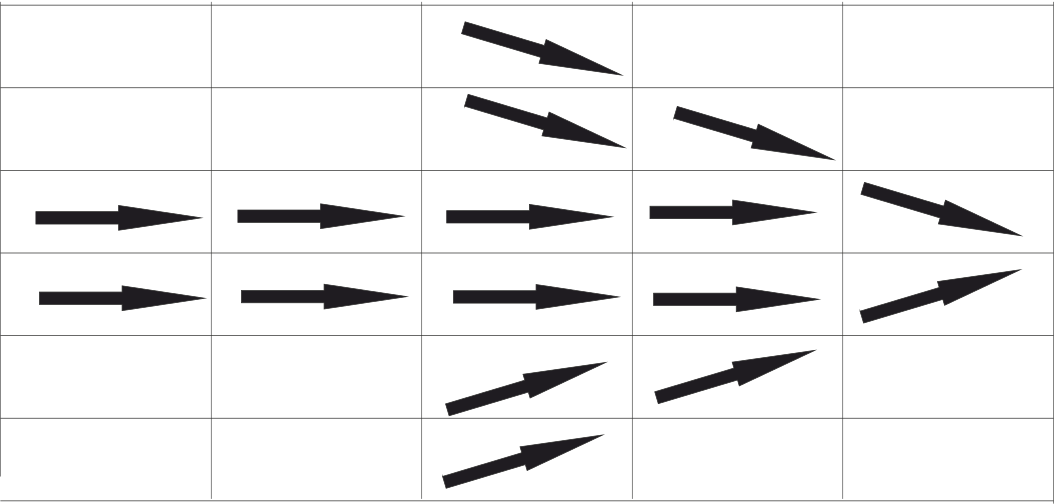
- What change occurred? What makes this difference?
we still have a set - only, one
the same number of elements, exactly the same
earlier each element had its own direction when lying in a group, and now they have a common one
Can we still say that this set is a “shapeless mass” that we’re afraid of?
We obtained something more than the sum of elements - structure, direction.
Do we know groups that are not just a set? (football team, Roman army, relay team)
Why do people want to be in them? Why do such groups form?
Exactly! Such groups form themselves, and no one forms them. Someone forms sets - by categorizing and cataloging (e.g. school principal establishing classes, official dividing people into those who will be served today and the next day). You can’t arrange people like that so they suddenly want the same thing.
Are we in such groups? What role do we play there? What is their goal?
Is your individuality respected in them?
Together, but individually?
The Church is also a group. A group that is indisputably categorized as a set - we’re aware of this. Because you can ask: where is there room for individualism if everything is established by others, and we have to submit…
Have you encountered such a perception of the Church?
Is this true? Let’s read a fragment:
Now Moses was tending the flock of Jethro his father-in-law, the priest of Midian, and he led the flock to the far side of the wilderness and came to Horeb, the mountain of God. There the angel of the Lord appeared to him in flames of fire from within a bush. Moses saw that though the bush was on fire it did not burn up. So Moses thought, “I will go over and see this strange sight—why the bush does not burn up.” When the Lord saw that he had gone over to look, God called to him from within the bush, “Moses! Moses!” And Moses said, “Here I am.” “Do not come any closer,” God said. “Take off your sandals, for the place where you are standing is holy ground.” Then he said, “I am the God of your father, the God of Abraham, the God of Isaac and the God of Jacob.” At this, Moses hid his face, because he was afraid to look at God.
—Ex 3,1-6
- Let’s pay special attention to verse 6. Let’s compare two versions:
“I am the God of your father, the God of Abraham, the God of Isaac and the God of Jacob”
“I am the God of your father, the God of Abraham, Isaac and Jacob”
How do we interpret that God introduces Himself using such a “strange form”?
Commentators of Holy Scripture interpret this as God’s emphasis on the individuality of His relationship with each person. Although the God of Abraham and the God of Isaac is the same One God, God’s relationships with Abraham and Isaac were different. It’s an apparent paradox that being in a group and individuality exclude each other.
Let’s read:
Just as a body, though one, has many parts, but all its many parts form one body, so it is with Christ. For we were all baptized by one Spirit so as to form one body—whether Jews or Gentiles, slave or free—and we were all given the one Spirit to drink. Even so the body is not made up of one part but of many. Now if the foot should say, “Because I am not a hand, I do not belong to the body,” it would not for that reason stop being part of the body. And if the ear should say, “Because I am not an eye, I do not belong to the body,” it would not for that reason stop being part of the body. If the whole body were an eye, where would the sense of hearing be? If the whole body were an ear, where would the sense of smell be? But in fact God has placed the parts in the body, every one of them, just as he wanted them to be. If they were all one part, where would the body be? As it is, there are many parts, but one body. The eye cannot say to the hand, “I don’t need you!” And the head cannot say to the feet, “I don’t need you!”
—1 Cor 12,12-21
Such is the community of the Church. It’s composed of individual persons although it’s “one body”. We’re not all supposed to be the same, we’re not supposed to think the same or feel the same. We are however “one organism” so we have a common direction (like the arrow example). We’re to be reconciled diversity (diversity in unity). This is possible.
Have you ever looked at the Church this way?
How do you understand the concept of “reconciled diversity”?
Do you believe that the Church is exactly like this?
Summary, application
I propose to do here an introduction to evening prayer. Ask people if they’ve taken part in something like this. Dispel their doubts. Room for animator’s witness how he experiences his individuality as part of something greater in prayer (our individual invocations create communal prayer. Communal prayer inspires us to individual invocations). Invitation to try to fight for something the same through these three days.
The application for participants should be such an attempt to look at people praying together.
Prayer
Decidedly thanksgiving for this meeting, but also for what’s ahead of us.