Meeting 1 — “On the Shore of Mystery”
Goal of the meeting
Meetings in groups “On the Shore” are to create primarily a space for dialogue and mutual listening to the voice of other members of the Church. The conferences preceding the meetings were subordinated to this goal - to inspire, to create a common experience, to which we can now refer together.
Today’s prayer is an expanded Lord’s Prayer. We want to “search where it seems that we already know everything”. The goal of this meeting is to explore such spaces in our spiritual life which perhaps “have become obvious” and through a common look seek in this something that will still be refreshing for us.
Community bonding - why are we on the shore?
A moment ago during the conference we heard about millions of offers that compete for our time and each makes a promise that it is important. However, we chose that we want to be here - why? Let’s use the answer to this question to get to know each other a little better.
How would you describe yourself in 5 sentences?
Why are you with us “on the shore” now?
Blurred boundaries
We spoke a lot today about boundaries that we automatically introduce into our lives. Often it is very reasonable and useful. Let’s try to do an exercise together.
Note
The animator takes out prepared boards with colored squares. Participants try to arrange the colors in the order of the color palette writing down numbers in a notebook - in the notebook there is also the answer key.
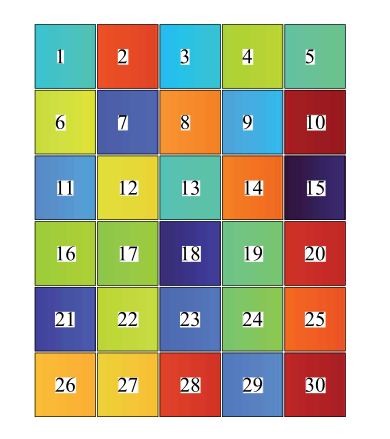
What feelings awaken in me when something that is continuous (spectrum) has been chopped up?
To what extent am I able to reconstruct the image of the whole by looking through details (fragments)?
Note
The animator takes out prepared boards with colored strips. One can see on them a missing element of the spectrum, which we did not have on the squares.

Were we able to notice that among 30 squares an important element is missing?
What experience from private life could we juxtapose with the exercise a moment ago?
When we want to know something, both the view of the whole and of the detail is important. Dividing the complicated issue of the history of Poland into smaller fragments of 20 years will facilitate our entering into details and real deepened knowledge about individual events. However, we should not stop at this - changing the perspective and capturing the topic more broadly can be critical for seeing repeating problems and motifs.
Note
This is a good place for the animator’s testimony. The author of the outlines has experience of so-called “Schools of Liturgy” where he became fascinated with detailed guidelines, made dozens of pages of notes, “became sensitized” (because mainly to “errors”) to parish liturgy and… very strongly lost at the same time the sense of the whole.
What from this exercise can we extract for ourselves in the space of our spirituality?
It is the same in the matter of faith and spirituality. If we look at conversations about religion, they most often concern very detailed issues: Should we teach religion in school or catechism rooms? Does taking medicine break the Eucharistic fast? What if, while praying the rosary, we skip one Hail Mary? Does excessive exploration of such details not increase the chances that something much more important will escape us?
Non-existent boundaries
Let’s read:
O Lord, thou hast searched me and known me!Thou knowest when I sit down and when I rise up;thou discernest my thoughts from afar.Thou searchest out my path and my lying down,and art acquainted with all my ways.Even before a word is on my tongue,lo, O Lord, thou knowest it altogether.Thou dost beset me behind and before,and layest thy hand upon me.Such knowledge is too wonderful for me;it is high, I cannot attain it.– Ps 139:1-6
The psalmist does not divide his life into “squares”. There is no “religious” and “ordinary” space in him. He has a deep awareness that God permeates his whole life.
At what moment does prayer begin? At what does it end?
We describe as “sacred” things that are related to our religion. What things or places are our sacrum?
Over the course of life has our profanum become sacrum? What steps can be taken for this to happen?
Many boundaries that we defined in our life serve us - they are useful. For example, we function better when we set ourselves time for relaxation and rest, because there is a smaller chance that we will forgo it. God himself during the creation of the world made important divisions - he separated waters from land, day from night, weekdays from the seventh day. However, we introduced some divisions that no longer serve us - they distance us from wisdom. The longing for the lack of tension resulting from “assignment” can be found in Isaiah:
Let’s read:
The wolf shall dwell with the lamb,and the leopard shall lie down with the kid,and the calf and the lion and the fatling together,and a little child shall lead them.The cow and the bear shall feed;their young shall lie down together;and the lion shall eat straw like the ox.The sucking child shall play over the hole of the asp,and the weaned child shall put his hand on the adder’s den.They shall not hurt or destroyin all my holy mountain;for the earth shall be full of the knowledge of the Lordas the waters cover the sea.– Isa 11:6-9
What categorization in my life is present so strongly that I have stopped even trying to reverse it even though I would very much like to?
What assignment of categories does not serve us in spiritual life?
Ability to let go
“Holiness does not mean doing extraordinary things, but doing ordinary things with love and faith.”
—Pope Francis (Twitter, December 2013)
As we heard in the conference, many things present themselves in an attractive way. They are “great”, “crazy”, “extreme” etc. Exactly the same can happen to our faith and experience of God. We experience this very often in harmless questions such as: “how was it at prayer today?” “how was it at mass?”. If we compared these questions to our other realities, we would notice very easily that something is wrong with them. How would we react to the question: “how was it in your marriage today?”. If it is simply “good” it means that we experience slow growth, our routine becomes soil for development. One cannot grow stably if our ambition is experiencing a revolution daily.
Let’s read:
“The ordinariness of everyday things is the abode of the silent mystery of God and His grace.”
—Karl Rahner
In what way does this statement resonate with my experience of God?
To what extent do I expect from my faith that it be extraordinary?
The path of humility and slow growth in love with God and people is shown to us by the Lord Jesus himself. We can find it not only in his public life, but also, and perhaps even primarily in the vast majority of his life spent in Nazareth. Thirty ordinary, simple years - childhood, growing up and adulthood, about which we know very little. Jesus was then an ordinary man, living like every other Palestinian. With his “hidden life” Jesus sanctifies our hearts wanting to experience great religious impressions. When we live our daily life, we live as Jesus did.
Let’s read:
O Lord, my heart is not lifted up,my eyes are not raised too high;I do not occupy myself with thingstoo great and too marvelous for me.But I have calmed and quieted my soul,like a child quieted at its mother’s breast;like a child that is quieted is my soul.– Ps 131
In what way do I meet God in my ordinariness?
Where do I feel in the Church/Faith “like a child at its mother’s breast”? Why do I think so?
What is hardest for me to let go of in the tension between my image of a believer and the awareness of how it works out for me?
This is a good place for the animator’s testimony concerning letting go of something in faith which really did not lead us to a deepened relationship with Jesus.
Application
What can I let go this year to give myself a greater chance to meet God in my life?