Meeting 2. - The desert shapes us
Goal
Show the good side of the desert experience – it is a potential gift for us that can be used or rejected. Sharing our experience of “lack” in life and on today’s Way of the Cross. The desert shapes!
Prayer
Adapted to the group’s capabilities.
Introduction
Yesterday we talked about the desert as a dangerous and threatening place, this is a natural reflex in perceiving it. Today we are after the “strange experience” of the Way of the Cross in silence. We experienced “difficult conditions of lack of movement” – this sheds some light on our experiencing of the desert. At today’s meeting we do not want to report wise books, but talk about what we saw/experienced.
What feelings do we have from the morning Way of the Cross? (not only spiritual)
Did something surprise us or particularly stuck in memory?
Did you have an experience of boredom or wasting time? What did you do then?
Note
animators: let’s destroy on the spot the tendencies for “good answers that the animator wants to hear” and provoke an open conversation
“Life goes on by itself, we skillfully adapt to it”
Where do our feelings on the Way of the Cross of some weariness/boredom/impatience/counting stations to the end come from? What was different in these 1.5h of our life compared to moments when we “feel that we are living”? We felt something that we try so hard to avoid every day. Let’s try to think about the source of these feelings.
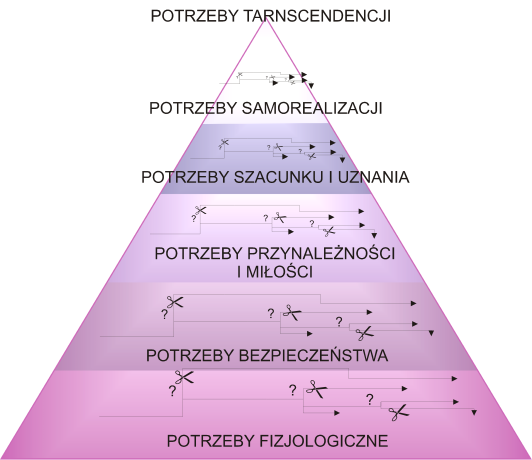
The animator distributes printouts to the group and tries to analyze them together with them. Below I include an example scheme:
What is this a pyramid of? Maslow’s hierarchy of needs How can you read it?
(that man has different needs and it is hard for him to concentrate on fulfilling others when earlier ones are not realized.)
What do you associate the diagram drawn on each layer of the pyramid with?
(It is a decision-making process running from left to right. Depending on which path I choose at the question mark I will come to other questions/other solution. Let’s skip the scissors for now.)
Can you give an example of such a decision scheme for individual layers of the pyramid?
(E.g. for physiological need when I feel thirst I decide to go to the store, when I get there I have to choose whether I will buy Coke or Kubuś.)
(E.g. for safety need, to ensure it I have to choose in which bank I will save money for the future, when I choose it I have to decide what amount I will pay there every month, and what I will leave “for living”, then I have to make a choice when I will use this money)
“Life goes on by itself, we skillfully adapt to it” – therefore the desert!
I understand. So what’s with these scissors? How do they relate to the Way of the Cross in the morning?
This question is the most important. Yesterday and today at the conference we talked about the fact that the Desert is a “lack of something”, just as the Way of the Cross “abounded in lack of activities”. In life, man develops certain schemes of action – when he lacks something he does this and this and this. This scheme works on each of the planes of the pyramid. The desert destroys these habits and beaten tracks of actions by changing the conditions of our life. Therefore scissors – certain choices made by us normally are now unavailable. This forces us to go a new way, this forces us to experience more.
Did you ever look in such a way at moments of desert in your life? Did you have an experience in your life of such a “cutting off the possibility that was normally chosen by you”? What was it? How do you remember it? (it’s about things not only from “upper layers”)
Do you have an experience of “seeing more” thanks to “forcing you” to choose another path by the circumstances of the desert?
Were you grateful to God for that later?
Desert – toil, sand in the eyes
However, we all agree that while “after” it is still easy to be grateful to God, when we are led out into the desert by the Spirit it is rather not pleasant. We often behave in such a way that as soon as we feel hot sand with our feet we start trying to jump out of it immediately thrashing about and often burying ourselves in it at this moment up to our knees. One “runs away” from the desert.
Can you “live through” deserts as something good? When it appears approach it like that right away?
Man has alternately a time of desert/desolation and a time of consolation. This is the rhythm of our spiritual life. We often think that the greatest development takes place in moments of consolation, that these are the “successes” that pull us forward – experience of God’s love, joy of being in the Church etc. Undoubtedly this brings closer to God. However, such an approach suggests that everything else outside this period is “wasting time”.
If you were to define what shaped Your personality, character to a greater extent - time of desert or time of joy, what would you choose? Why?
Note
one of the most important questions of this meeting
“The desert shapes, because it introduces the new through lack”
How do you understand this sentence? How do you explain this paradox?
Can you share an experience of such shaping in Your life? (do not press for an answer!)
People’s reaction to crisis/deserts is sometimes strange. Maybe we have had the experience more than once that when we want to share “our desert” with our loved ones they react like the fire brigade, which immediately does everything to “fix” this situation i.e. remove it. Similarly, the desire to go to the desert (retreat) on one’s own can sometimes meet with, to put it mildly, misunderstanding.
How do I react when someone shares the experience of the desert with me?
Do I know a person who did not try to “remove” the crisis in helping, but tried to make me pass through it as fruitfully as possible?
Warning
This question can refer to very intimate relationships e.g. male-female. Example: The guy tries to remove the blues of the chosen one as quickly as possible so that it is cool again and they can spend time “as always”. Thus it is an important place of group meeting
Persevere to the end
Therefore, one should not run away from the time of desert, but use it as best as possible. I think that the most common mistake in the desert is lack of patience. The desert is a “boundary experience” which allows opening a new chapter, giving a new look at some stage of life. An example here can be despair and spiritual desert of Judas after betraying Jesus. This experience of emptiness led him to a fatal decision to take his own life. If he managed to survive this night and get up… Let’s see how much Mercy would triumph, how great testimony it would be if he taught about the forgiveness of sins etc. Who knows – maybe he would be one of the greatest saints.
Let’s read now the poem by Jacek Kaczmarski “One step”. Let each of us mark in it the “verses closest to him”.
“One step from the source they are dying of thirst.One step from hell they go mad with delight.They sober up from dreams one step from fulfillment.One step from the goal their own shadow scares them away.One step from triumph they lower their heads.They raise their heads one step from the sentence.One step from grace they lose the gift of speech.A step from the abyss they quicken their pace.One step from revenge suddenly great in spirit.One step from the way they wander in vain disputes.One step from the deed they prefer fragile phrases.One step from tomorrow they relive yesterday.One step from agreement empty anger takes them.One step from knowledge they inhale superstition.One step from God they deny faith.One step from themselves they do not want to become themselves.One step from death life is not dear to them.One step from life they dream past torments.They gather books one step from the conflagration.One step from defeat they feel most cheerful.So for an hour, day, month, yearUntil they take that one inevitable step.”—Jacek Kaczmarski
Which verses did you choose? Can you say why?
Do we have trust in the time of desert and difficulty that we will finally wander to the Oasis if it will be good for us?
Nothing is the same anymore
Those who experienced the desert and passed through it change their view on many matters. Often the fruit is respect and humility towards God, nature, other people. These are the basic fruits by which one can discern how the desert was used.
Was there such a situation that after some experience of the desert Your looking at some matter changed strongly?
Being in the desert do you allow yourself the courage to “change You” or do you defend yourself against it?
Summary
The desert shapes us. These are the moments of our life which perhaps have the strongest influence on the whole of our person. The desert provokes us to go beyond beaten schemes giving satisfaction.
As an application after this meeting let’s thank now in prayer for every experience in our life and let’s try not to ask for any specific one, but for those that God wants to give us at this moment.