Meeting 2 - “One thing you lack…”
Meeting Goal + Introduction for the Animator
The meeting is long. To avoid fatigue with questions and answers, halfway through there is a workshop designed to activate people. Do not try to ask all the questions from the outline (there are 35 of them!), because time will not allow you to do so - treat them as guidelines for leading the meeting. Remember that the most important thing is meeting God in the Scripture and with each other, not completing every sentence from the outline.
- Goals:
Getting to know the teaching of the CCC on the subject of freedom.
Getting to know spiritual discernment and presenting it from a positive side.
Preparation for evening prayer by awakening the desire for active and conscious participation in prayer.
Introduction
Yesterday we talked about how many secondary matters we deal with in our lives. We saw Jesus who wants us to concentrate on what is really important. We told Him in the evening prayer: “Lord, open my eyes, my mind and heart”. This morning we talked about God who answers our requests, who cooperates with us. God answered. In the Tent of Meeting we heard clearly: “be doers of the word, and not hearers only, deceiving yourselves”. These are joyful words, but anxiety may also appear in us - how am I to do this? Can I? Today we want to talk about how to recognize what is important, what is more important, and what is most important.
What on the retreat since the last meeting was most important for you? What gave it that rank?
How do you feel when you have to choose one, most important thing? Would it be easier for you to list three important things or one most important? Where does this come from?
If you had to describe the evening prayer using 5 keywords, what terms would you choose?
Freedom
Often at religious meetings we listen to many wise and beautiful words about freedom, choosing, discerning, converting, discovering. Let’s take three steps back at the beginning of this meeting and wonder: Why do things need to be recognized? Why do we have to choose? Why do we have to search? Why do we have to struggle? Why didn’t the Good God give us all this in black and white? Why isn’t it easier? Let’s check what the Church says about this:
“Freedom is the power, rooted in reason and will, to act or not to act, to do this or that, and so to perform deliberate actions on one’s own responsibility. By free will one shapes one’s own life.”
—Catechism of the Catholic Church 1731
Let’s ask:
When do you feel most free?
Do you prefer to choose which movie you go to the cinema yourself or do you prefer someone to suggest one to you?
In what spaces do you like to decide/choose, and in which not?
God wants us to search, recognize, choose. Our life consists of millions of smaller or larger choices. We choose everything - from the socks we put on this morning, through the people we will bestow with friendship, to the most important values for which we will be ready to give our lives.
“Freedom exercises its relationship to truth in its choice of actions. Freedom makes man a moral subject. When he acts freely, man is, so to speak, the father of his acts. Human acts, that is, acts that are freely chosen in consequence of a judgment of conscience, can be morally evaluated. They are either good or evil. Freedom makes man responsible for his acts to the extent that they are voluntary. Progress in virtue, knowledge of the good, and ascesis enhance the mastery of the will over its acts.”
—Catechism of the Catholic Church 1732-1734 (paraphrased/combined in original text, referring to 1732-1733)
“As long as freedom has not bound itself definitively to its ultimate good which is God, there is the possibility of choosing between good and evil, and thus of growing in perfection or of failing and sinning. This freedom characterizes properly human acts. It is the basis of praise or blame, merit or reproach. The more one does what is good, the freer one becomes. There is no true freedom except in the service of what is good and just. The choice to disobey and do evil is an abuse of freedom and leads to ‘the slavery of sin’.” (CCC 1732-1733)
We talked about this at previous retreats. The Apostles gaze into heaven, and then return and choose. These are not choices between good and evil, but choices between good and greater good.
Note
If someone was not at the previous retreat, nothing bad will happen from such a reference - it is not necessary to experience this meeting well. However, it is worth promoting spiritual development as a process, not an event.
What choice between good and greater good have I made recently?
Which of my decisions are most marked by this reference point?
The CCC says that the concept of freedom changes during maturation. How has your understanding of freedom changed recently?
Freedom is not easy. Original sin is nothing else but the misuse of the gift of freedom. The moment when man wants to decide for himself what is good and what is evil, as well as what is important, not trusting God in this regard.
What seemingly limits freedom, for example commandments or law, is necessary at a certain stage. Just like raising a child, to give him a sense of certain stability and security, we establish a system of rules and principles prevailing in the house. It is a matter of maturity - one has to mature to the Augustinian “Love and do what you want”. Freedom in love sometimes consists precisely in the voluntary choice of something that seemingly limits my freedom.
I Discern Because I Am Free
Let’s read:
“Woe to you, scribes and Pharisees, hypocrites! For you tithe mint and dill and cumin, and have neglected the weightier matters of the law: justice and mercy and faithfulness. These you ought to have done, without neglecting the others.”
– Matt 23:23
What do I think is most important in keeping the commandments?
What do I think is due to God from my life?
What can be balance in keeping commandments?
Note
Regarding commandments, it is important to remember the order itself, we often tend to focus on those further commandments (e.g. on the sixth), because they cause greater remorse, while not without reason the most important ones are at the beginning.
So maintain balance! The Pharisees chose priorities in their lives wrongly. It’s hard to say that keeping the law of tithe is something bad. Evil is neglecting the most important. Did the Pharisees do it on purpose? Or maybe they just got lost in all the rules and commandments? Didn’t we discover yesterday ourselves that we tend to lose the most important thing from sight?
Let’s read:
“Look carefully then how you walk, not as unwise but as wise, making the best use of the time, because the days are evil. Therefore do not be foolish, but understand what the will of the Lord is. And do not get drunk with wine, for that is debauchery, but be filled with the Spirit, addressing one another in psalms and hymns and spiritual songs, singing and making melody to the Lord with your heart, giving thanks always and for everything to God the Father in the name of our Lord Jesus Christ,”
—Eph 5:15-20
In what matter are you “trying to understand what the will of the Lord is” currently?
What is characteristic of wise conduct?
Why does St. Paul combine “trying to understand” with encouragement to sing, give thanks and be filled with the Holy Spirit?
Note
Adapt to the age group. It is worth the animator sharing their testimony here as encouragement.
Christian discernment is full of joy. Discernment between good and good is the realization of the gift of freedom that we received from God and which distinguishes us among other creatures. Every choice made is in a way a celebration of our humanity. We want our choices to be true and serve the Truth.
Let’s read:
“If you abide in my word, you are truly my disciples, and you will know the truth, and the truth will set you free.”
—John 8:31-32
What is the basic condition that each of our choices must meet?
If someone asked you in an elevator what the teaching of Christ is and you had 60 seconds to answer - what would you say?
The truth mentioned in this passage is the Greek aletheia (from a-lethès, “not hidden”). Truth is not something that needs to be discovered (the statement “Hidden truth” is almost a paradox). It is always overt. Only we must look in the appropriate way, get a perspective that will allow us to see it. Certainly the Holy Spirit helps us in this - called by Jesus the Spirit of Truth. It is thanks to His action that we are able to look at the world through the prism of God’s logic and act in accordance with His will, contributing to building the Kingdom.
Did Jesus hand us solutions on a platter on how to search for a good decision? No. However, He gave us His Spirit and the Community of the Church, which for 2000 years has been learning and perfecting itself in discerning God’s will. He also gave a promise that we will know the Truth if we are truly His disciples.
How do you recognize that something is the Truth? How do you verify it?
Let’s try then as people of the Church to join this age-old tradition :) and together wonder how to make certain choices “in a Christian way”. These will be choices between good and good. Let’s not focus therefore on what is “good and what is bad”, but on the very way of discerning a given topic.
How to Discern?
The group can choose a matter for discernment itself, but one can just as well use our proposals. Attention should be paid so that in a group where few people have experience of the Church community, not to choose an example that is based on this. If you don’t know this about your participants yet - ask. We probably won’t avoid the discussion “what is objectively better” :) - let’s not kill such a direction by force, but let’s keep it under control - the most important thing is talking about the PROCESS of discernment. If time allows, you can talk about more than one example. We want to catch key elements in it:
Prayer of petition to the Holy Spirit
Gathering at the level of reason the consequences of path 1 and path 2
The more serious the decision, the more serious the discernment - appropriateness of time to matter (Spending more than 15 seconds on choosing whether to eat a slice with strawberry jam or plum jam borders on scrupulosity and wasting time, which is a gift from God)
Possibility of using an objectifying source (e.g., Priest, animator, friend)
Taking into account the duties of the state (pro)
Maturity of spiritual life - reference to earlier discernment processes and their consequences. Element of retrospection (Sometimes it might have seemed to me that something was good, but it wasn’t. The world doesn’t end, but it’s worth remembering for the future).
Entrusting the consequences of our decision to God
Note
Ordo Caritatis - First duties towards God, Towards the closest ones (family), tasks of the state (school, professional work). [If I have a choice between preparing for a test and preparing a group meeting, I should choose preparing for the test. If not due to my negligence I face a dilemma to go to Holy Mass on Sunday evening or study for a test - I should go to Holy Mass]
We refer to what the participants say and develop points with knowledge from footnotes. The goal is for the meeting participants to see spiritual discernment more broadly in practice. If there are points from the above list that the group does not approach, let’s ask them directly what they think about such an element. Let’s avoid the feeling of “hitting the key”.
- Proposed dilemmas:
Go with friends to the mountains for the weekend or participate in the Vigil of Pentecost in the parish.
Take the final exam in physics or chemistry
Write your own meditations for the Way of the Cross or use ready-made meditations of St. John Paul II
Study a field that is future-proof and economically justified, or one that is related to my passion.
Stay on fb in conversation with a friend who is crying because her boyfriend dumped her, or go to a long-planned hen party of a colleague / eighteenth birthday of a friend
Auxiliary questions:
What should be done first?
Why is it worth doing a given activity?
How will this thing facilitate our decision making?
Warning
This is the place for the animator’s testimony about their spiritual discernment. You can talk about something you have already discerned and is behind you. You can talk about discernment that is ongoing. The key is to testify that we are in this with Christ and joy is possible now, not only when we finally decide.
Sincere Motivation
In the process of discernment and beyond, an important element is the question of our motivations and intentions. We often consider some things important only because we think we should think so. Witold Gombrowicz wrote in Ferdydurke: “Why does Słowacki arouse admiration and love in us? (…) Because, gentlemen, Słowacki was a great poet!”. Our personal importance of things cannot be imposed from the outside by opinion, rule, principle. What value does it have then? Even referring to the greatest authorities will not change anything. When we say to someone “I love you because Jesus ordered me to love you” it sounds downright painfully sad and I doubt that Jesus cared about realizing the Commandment of Love he left us in this way. The most important things must come from us, they must be sincere, true - “I love you because I want to!”.
Let’s look at a certain situation from the Scripture, which also concerned an important choice.
Let’s read:
“Now as they went on their way, Jesus entered a village. And a woman named Martha welcomed him into her house. And she had a sister called Mary, who sat at the Lord’s feet and listened to his teaching. But Martha was distracted with much serving. And she went up to him and said, “Lord, do you not care that my sister has left me to serve alone? Tell her then to help me.” But the Lord answered her, “Martha, Martha, you are anxious and troubled about many things, but one thing is necessary. Mary has chosen the good portion, which will not be taken away from her.””
—Luke 10:38-42
Did either of the sisters choose evil? (No! Care for the proper reception of a guest is an element of culture)
What could have been Martha’s motivations, and what Mary’s? (E.g. Did Martha really, sincerely want to serve? Or do what is appropriate? What did she think she should do?)
How did Martha’s attitude differ from Mary’s attitude? (Here, to let it resound that Martha compared herself to her sister - “I’m toiling here, and she is slacking off”, meanwhile Mary was simply doing her thing.)
Martha’s concern for hosting the Lord Jesus worthily was nothing bad. We do not question that her readiness to serve, thanks to which others could focus on listening to Jesus, was admirable (leaving aside the fact that in that culture hospitality was so important that in sum, from the point of view of custom, it is Mary who acts badly…). Perhaps, however, she unnecessarily compared herself to her sister. It could have resulted from the fact that she felt worse because she focused on more mundane things, or felt treated unfairly, wronged. Meanwhile, Jesus talks about the best part - that something of my own, which I do sincerely, which is mine and I do not have to compare it with others, which cannot be taken away from me.
How often do I think about my motivations? How often do I analyze my own intentions?
What is difficult about being honest with yourself?
How can our purification of motivation in matters of faith look like in the 21st century?
The key is asking yourself often the question “what am I doing this for?”. “Why do I come to Oasis?”, If really for prayer, would I still attend just as willingly if all meetings and trips and games were removed from Oasis? Do I serve as an animator because I want to imitate Jesus Christ or maybe the title of “animator” and the possibility of access to an elite group is also important to me? Do I read the Scripture because I want to know the history of faith? What does my skipping of historical books and distinct tendency to search for “aphoristic” quotes testify to?
Interestingly, in the Gospel of John we can read that during the anointing in Bethany Martha continued to serve, but she no longer complained that she was working and Mary was anointing with oil. Some change took place in her, she understood what her best part was. Understanding this, however, probably involved making some effort, some development, concrete work that had to be done. We can assume that Martha decided what was most important for her and decided to stick to it ultimately.
“So they made him a supper there, and Martha served, but Lazarus was one of those at table with him. Mary took a pound of costly ointment of pure nard and anointed the feet of Jesus and wiped his feet with her hair; and the house was filled with the fragrance of the ointment.”
—John 12:2-3
We Assign Value
We also at different stages of our life have to define ourselves as to what is most important to us. We want to decide as consciously as possible about what values we are guided by and which of them we realize. We cannot assume that everything is important, because when everything is important, suddenly it turns out that really nothing is (inflation of values).
How do I recognize that something is important to me?
What constitutes value?
Who assigns value? How much depends on me?
What is my determinant of value?
Let’s read:
“But whatever gain I had, I counted as loss for the sake of Christ. Indeed, I count everything as loss because of the surpassing worth of knowing Christ Jesus my Lord. For his sake I have suffered the loss of all things and count them as rubbish,”
—Phil 3:7-8
For St. Paul, valuable is what helps him know Jesus better, deepen the relationship with Him in some way. This is his criterion.
In what way and to what extent does my faith decide about my values?
Let’s read:
“You are the salt of the earth, but if salt has lost its taste, how shall its saltiness be restored? It is no longer good for anything except to be thrown out and trampled under people’s feet. You are the light of the world.”
—Matt 5:13-14
When value ceases to be valuable - when salt loses its taste. We are salt, we are to shape values around us. We must be aware of our own value, which determines the choice of what is most important.
Today during the night silence we will want to reflect on our assigning of values. We distribute ready-made sheets on which there is a circle divided into eight semi-axes, into which we write the values chosen by us. Each of them has its axis with numbers from 1 to 10, on which we will mark how much I actually realize a given value at this moment, and how much I would like to realize it (can be in different colors).
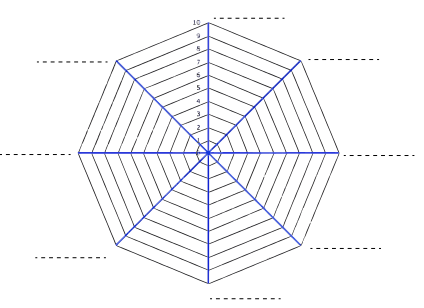
After doing this exercise, talk tomorrow during free time with any person from this retreat answering the questions on the back of the sheet:
What was easy and what was difficult in creating such a circle?
What did it give me?
What surprised me?
What are my conclusions?
On the realization of which value would I like to focus most in the near future?
Being a Conscious Participant, Not an Observer
Let’s read:
And as he was setting out on his journey, a man ran up and knelt before him and asked him, “Good Teacher, what must I do to inherit eternal life?” And Jesus said to him, “Why do you call me good? No one is good except God alone. You know the commandments: ‘Do not murder, Do not commit adultery, Do not steal, Do not bear false witness, Do not defraud, Honor your father and mother.’” And he said to him, “Teacher, all these I have kept from my youth.” And Jesus, looking at him, loved him, and said to him, “You lack one thing: go, sell all that you have and give to the poor, and you will have treasure in heaven; and come, follow me.” Disheartened by the saying, he went away sorrowful, for he had great possessions.
—Mark 10:17-22
What can be surprising in the young man’s attitude? (desire for more)
It is worth noting that Jesus looked at the young man and loved him, knowing that he would be saddened, that he would not be ready to follow Him. But despite this, he loved him. We too may not feel ready. Have the impression that it is too much for us, that it overwhelms us. But let’s remember that God loves us in this. And gives us time to mature to certain decisions. We do not know if after some time the young man did not return.
For the whole retreat we talk about important and most important things. We learn to distinguish and name it by name. We will go together to evening prayer today to say: “God, I want to entrust all this to You! Take care of it, care for it. Do not let me forget about what is important to me! Do not let it turn into my obsession. Introduce order. You are next to me, I know that you love me. I give myself to You”.
Tell the participants why it is important for you that they stand before Jesus today together with you (it is important for us that participants go to every point of the program, it is more important for us whether they feel respected here, but most important is whether they meet Jesus). Tell why it is important not so much to look at the Church, but to be the Church. Give testimony about the difference between talking about God’s love and trusting God. It depends on us the value of things, time, meetings. Tell them about what is the most important thing for you.
Note
important < more important < most important is the synthesis of the retreat up to this moment. Show it in practice from Your perspective!
Prayer
For each other for openness and trust in the Love of God, who wants to meet us.