Meeting 2 — “Let Him Come to Me”
Introduction for the facilitator
This meeting is based on two important elements related to celebrating Sukkot - the tradition of inviting guests to the tent, and carrying water from the pool of Siloam. We want to treat these customs as a starting point for reflection on our own faith and its three aspects - hospitality (inviting faith), toil (demanding faith) and freedom (liberating faith). During the meeting we will use materials found in the notebook, so it is worth ensuring before the meeting that participants have them with them. Not all questions must be asked, however we care that all three aspects of faith are touched upon. We do not propose any specific prayer for the beginning and end of the meeting, we leave freedom in this matter. We believe that every animator will adapt the content of this meeting to their group so that it is as fruitful as possible ;)
Introduction
We are after the experience of building a tent together and an online conversation with special guests. Let’s share our impressions briefly:
What was building the tent for me? What do I take from this for myself?
What did I remember most from the conversation conducted with our guest?
If I could invite any person to our tent - who would it be? Why this person?
Let’s look closely now for a moment at the tradition of inviting guests during Sukkot itself.
Inviting faith
In Jewish tradition it was believed that every day of the Sukkot holiday the hut is visited by spiritual ancestors of the Jewish nation, known as Ushpizin (from Aramaic: “guests”).
Abraham for example left his father’s house and went to a foreign land at God’s command. Joseph was sold into slavery to Egypt. And Moses fled from Egypt to Midian, where he met God in the burning bush. Just as Ushpizin abandoned what was known and comfortable, in the service of God’s command, so we in Sukkot leave the safety of our homes for a temporary shelter at God’s command. This tradition teaches us that true faith is inclusive, open to everyone. The Sukkot holiday is designed so that everyone finds themselves in it.
Faith is not a closed circle intended only for the chosen ones – it is an open home in which everyone will find a place. It is not us who are hosts of faith, but it receives us, invites and gives us space to grow. Regardless of our history, weaknesses, doubts or falls, faith accepts us as we are.
How do I receive faith? How in the space of my life do I discover its hospitality?
In what way can I learn to accept faith as a gift, and not as property?
The Sukkot holiday for Jews is a joyful holiday. Celebration, joy from revealed truth. The source of faith in itself is to constitute an invitation for everyone who is still looking for this faith:
You shall keep the feast of booths seven days, when you make your ingathering from your threshing floor and your wine press; you shall rejoice in your feast, you and your son and your daughter, your manservant and your maidservant, the Levite, the sojourner, the fatherless, and the widow who are within your towns. For seven days you shall keep the feast to the Lord your God at the place which the Lord will choose; because the Lord your God will bless you in all your produce and in all the work of your hands, so that you will be altogether joyful.
—Deut 16:13-15
What is the biggest challenge for me, in such a form of inviting people who are still looking for truth?
What can I do to turn my experiencing of faith into the Feast of Sukkot?
One of the elements of the Sukkot holiday was “gathering” symbolic props: etrog fruit, date palm branch, myrtle and willow:
On the fifteenth day of the seventh month, when you have gathered in the produce of the land, you shall keep the feast of the Lord seven days; on the first day shall be a solemn rest, and on the eighth day shall be a solemn rest. And you shall take on the first day the fruit of goodly trees, branches of palm trees, and boughs of leafy trees, and willows of the brook; and you shall rejoice before the Lord your God seven days.
—Lev 23:39-40
The animator shows prepared illustrations of props signed with their features and illustrations of people’s features (e.g. Is pious, but does not know Torah). The participants’ task is to match the prop to the feature describing the human.
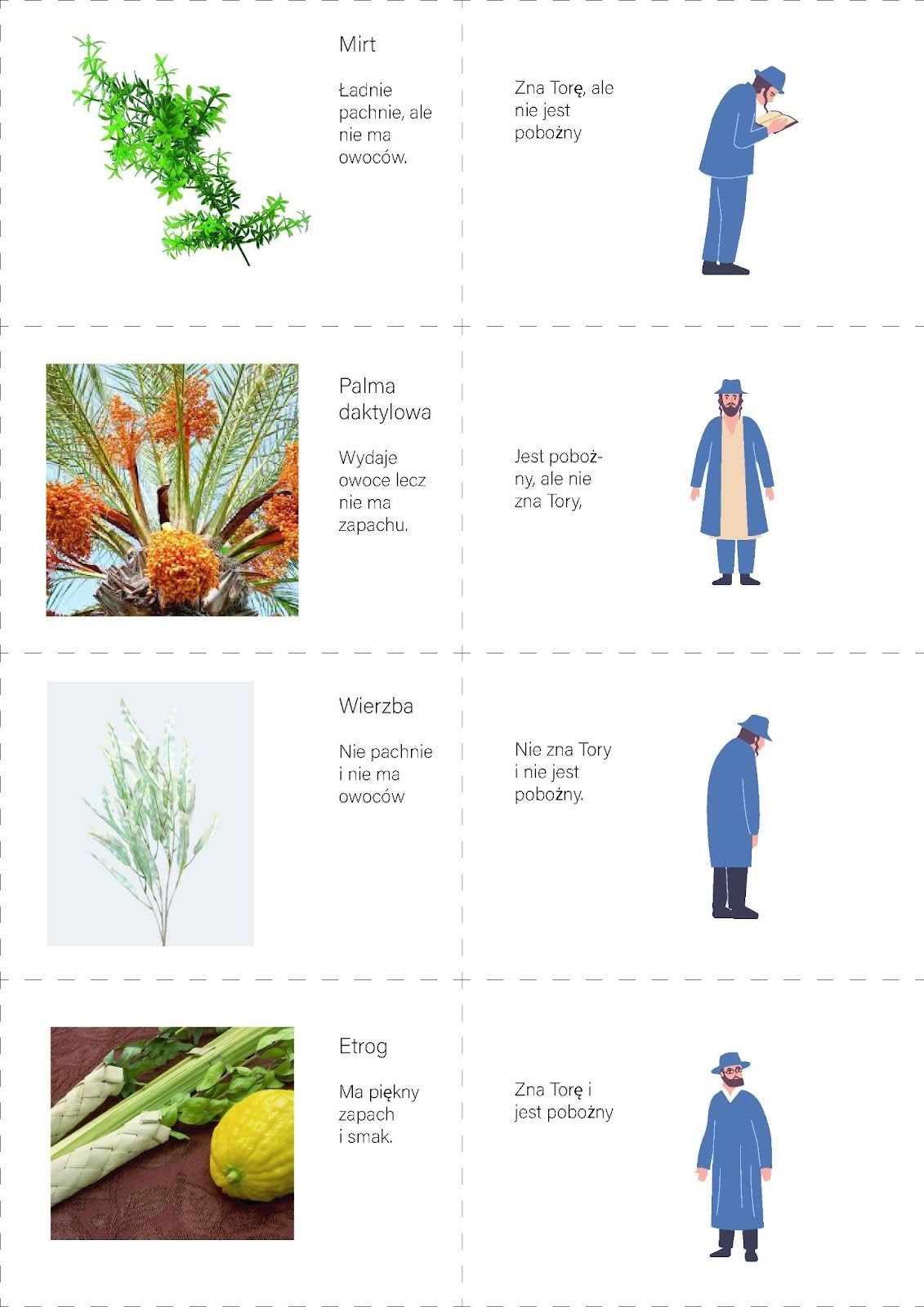
The rite of gathering four Sukkot props makes us aware that each of us, despite unique features, experiences and traditions, is an inseparable element of a larger community. It reminds that the diversity of our beliefs and ways of life enriches the whole, and each of us brings a significant contribution to building a harmonious and coherent world.
How do I perceive faith that receives us believers as its guests – both those deeply devoted, those from tradition, educated but non-practicing, as well as those who feel distant from God?
Celebrating important and joyful moments in our life often makes us want to celebrate them together with as many people as possible. A good example of this can be a wedding, to which we most often invite closer and further family as well as friends and acquaintances from different environments. Everyone unites on this day together with the young couple in common joy. How much such a perspective in faith can change looking even at the Eucharist itself, which definitely more than a collection of some rituals known only to the initiated, is primarily a feast that gathers us at one table.
Demanding faith
Note
This point is based on chapter 9 of the Gospel of John, which tells one story in its entirety. During the meeting itself we read only the most key fragments, however we encourage facilitators to read the whole as part of preparation, this will allow for a wider grasp of the context.
An important element of experiencing the Sukkot holiday is also the rite of drawing water from the pool of Siloam. The priest carries a filled pitcher to the temple to pour it on the altar there, asking for rain and harvest - this rite became not only a request for opening the gates of heaven and sending down abundant winter rains, but with time, when desires for changing the situation increased, when spiritual hunger grew among the children of Israel, it became a cry for pouring out springs of salvation, Ruach HaKodesh, on the parched earth of human hearts, matters and fates. The path the priest covers is not easy and pleasant - the route led uphill and was not too short.
Let’s look now at the story from the Gospel, in which a certain person had to cover the same path:
As he passed by, he saw a man blind from his birth. And his disciples asked him, “Rabbi, who sinned, this man or his parents, that he was born blind?” Jesus answered, “It was not that this man sinned, or his parents, but that the works of God might be made manifest in him. We must work the works of him who sent me, while it is day; night comes, when no one can work. As long as I am in the world, I am the light of the world.” As he said this, he spat on the ground and made clay of the spittle and anointed the man’s eyes with the clay, saying to him, “Go, wash in the pool of Siloam” (which means Sent). So he went and washed and came back seeing.
—Jn 9:1-7
Healing a person blind from birth is considered by Jews as one of the most extraordinary miracles, which requires special intervention of God himself. Jesus first creates clay and puts it on the eyes of the sick person, then orders him to wash in the Pool of Siloam, symbolizing the Holy Spirit, whose sending he announces. Jesus not so much performs healing, as creates this man anew, just as God formed Adam from the dust of the earth and breathed into him the breath of life. Healing did not happen immediately, the blind man first had to cover the way to the pool, to then return changed. First he had to experience weakness and total dependence on others, to be able to see. Faith requires from us confrontation with our own sinfulness and is a path to cross, which although exciting and joyful, can also be difficult and demanding.
In what way would I describe my spiritual development? What was most difficult for me on this path?
In what spaces do I feel most dependent on others?
What in me must be created anew?
The story of this blind man described in the Gospel does not end with the healing itself. Due to its great importance and moreover being performed on the Sabbath, it arouses considerable interest among Pharisees, who summon this man and his parents for questioning. They want to undermine credibility and question Jesus’ ability to perform such a great miracle, however the questioned declares that his healer must come from God, because otherwise he could not restore his sight. This ultimately results in throwing him out of the synagogue, and thus, exclusion from the community. Previously alienated due to disability, now rejected due to faith in Jesus, he meets him again - let us read:
Jesus heard that they had cast him out, and having found him he said, “Do you believe in the Son of man?” He answered, “And who is he, sir, that I may believe in him?” Jesus said to him, “You have seen him, and it is he who speaks to you.” He said, “Lord, I believe”; and he worshiped him. Jesus said, “For judgment I came into this world, that those who do not see may see, and that those who see may become blind.”
—Jn 9:35-39
This is one of the few cases described in the Gospel when Jesus meets again the person he healed. The Son of Man is no longer for this man an unattainable, anonymous Messiah, but someone whom he met and experienced His action. Now, when he saw, he has readiness in him to risk and bet everything on the One who healed him.
When did Jesus become for me the one I saw?
In what issues is it hardest for me to trust God?
What does it mean for me to believe?
The rite of carrying water from the pool of Siloam to the temple is repeated for seven days in a row. Despite the toil associated with it, it has an extremely joyful character - rabbis looking back, said that whoever did not see the ceremony of drawing water, did not see true joy in their life. Faith requires constant conversion, constant work on oneself and at the same time total entrustment to God and awareness of how much we are dependent on Him. However, this perspective also has something liberating in it.
Liberating faith
A special moment during the celebration of Sukkot was the seventh day - great worship - Hoshana Rabbah, experienced in great excitement, being at the same time a prayer for salvation from sins and forgiveness. In the Gospel of John we have described an event that took place exactly then:
On the last day of the feast, the great day, Jesus stood up and proclaimed, “If any one thirst, let him come to me and drink. He who believes in me, as the scripture has said, ‘Out of his heart shall flow rivers of living water.’” Now this he said about the Spirit, which those who believed in him were to receive; for as yet the Spirit had not been given, because Jesus was not yet glorified.
—Jn 7:37-39
How does faith in Christ liberate according to this passage?
Jesus does not criticize the practice itself, but points out that the traditional ritual is only a foreshadowing of what is to come fully in His person and through the gift of the Holy Spirit. Through the metaphor of “living water” Jesus shows that true blessing does not come from external rituals, but from a deep relationship with God, which transforms life.
This reinterpretation emphasizes that faith that liberates does not consist only in observing rituals, but in opening the heart to the action of the Holy Spirit. This opening brings internal transformation and renewal, which exceed what traditional rites give.
What differences do you notice between formal observance of rituals and authentic experience of transformation of heart? What are your reflections on this subject?
In what way caring for preserving rituals can I experience living faith?
How do you interpret the concept of “living water” in your life?
Summary and application
Going through Jewish traditions we met with three aspects of our faith: hospitable, demanding and liberating. Faith is a gift we received. Each of us experiences our faith in a different way. Preparing for the upcoming conference let’s ask ourselves questions:
For which of the aspects am I most grateful to God?
Which aspect of my faith requires special work from me?