Meeting 1. - Our Heart is Restless
Goal of the Meeting
to see a person in the context of their desires
to see that even small desires sometimes go beyond temporality
to prepare for a proper experience of “night activities” (writing on the walls of the labyrinth of desires)
Introduction for the animator
There is very little time for the meeting, only 45 minutes. From the outline, you need to choose what seems most likely to “work” or do it sequentially with the understanding that the beginning of tomorrow’s (1.5h) meeting will be devoted to completion. You absolutely cannot skip the application!
Please treat getting acquainted in the group very technically (that’s why this outline doesn’t include it) and instead of “talking about who we are”, let’s show it by going into deep water.
Opening prayer
Adapted to the group’s capabilities.
Life stretched on desires
What are desires?
What does the fact that a person desires indicate?
What are the desires of modern man? (The group creates a diagram - without totally stereotypical thinking, but not avoiding it when it is accurate)
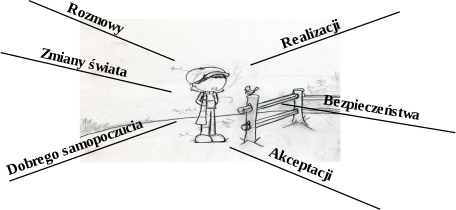
A closer look at the structure of our desires
Note
Probably no one will write in the above exercise simply “desire” as the need to consume fluids (if so, it doesn’t matter).
Dynamic: The animator pulls out a cup of water and says: “Oh how I desire to drink!”
Is this also our desire or just a play on words?
Why didn’t such desires appear on our card?
Why do I really have such a desire?
Goal: To make the group aware that small desires are embedded in larger ones, e.g., the fact that I desire to drink is an element of my desire to sustain my life. The animator must show their own ingenuity at this point to adapt to the group and reach them!
Let’s try to highlight (with color, frame, underline, etc.) the main desires on our drawing, indicating which could be the “embedded” ones. If necessary, you can add some new ones.
Our restless heart!
Let’s look at how many of these desires cannot be satisfied. When I desire a computer with Intel Pentium IV, in a year I will already desire to have Intel Pentium VII. When I have a garage with a garden that I saved up for over 5 years, I will desire to build myself a pool, etc.
(discussion) Do desires force a person into constant chasing and struggling in their life?
Note
this question may be worth centering the meeting around — if the group engages with it, don’t interrupt them or rush through the outline!
Do you notice this constant chase for satisfying your desires in your life? In the life around you?
Note
You can tell here about modern advertisements that convince us that we should still desire something, so that we constantly want more… so that the economy develops
The answer to this situation, which is a question (!)
Play a scene, read with role division or something like that:
Then the mother of the sons of Zebedee came to Him with her sons and, bowing down, asked Him for something. He asked her: “What do you desire?”
—Mt 20,20-21a
Goal: to extract the contrast: a person comes and asks “for something” (which was not important enough, since it was not written down), and Jesus responds with a question about the essence of what we came to him with.
Has anyone ever asked you such a question? Who?
(Has anyone ever asked what is most important to you?)
Conclusion: Jesus asks us about this because He recognizes that our desires are important!
A question arises: Why are desires important? (the group may try to answer it themselves)
The animator gives theses, and the group tries to explain each of them by giving a specific example. At the end, the animator gives their example.
Desires are good, because observing what desires arise in us tells us a lot about ourselves. [“Gosh, I want to have a bike like Kuba even though such equipment is useless for me!”]
Desires are good, because our reaction to them tells us a lot about ourselves. [Gen 18,9-15]
Let’s read:
They asked him: “Where is your wife, Sarah?” - He answered them: “In this tent”. One of them said to him: “At this time next year I will return to you, and your wife Sarah will then have a son”. Sarah was listening at the entrance to the tent, [which was] right behind Abraham. Abraham and Sarah were very old. So Sarah no longer had the condition proper to women. So she smiled to herself and thought: “Now, when I have passed my prime, am I to experience pleasure, and my husband is an old man?” The Lord said to Abraham: “Why did Sarah laugh and think: Will I really be able to bear children when I am already old? Is there anything that would be impossible for the Lord? At this time next year I will return to you, and Sarah will have a son”. Then Sarah denied it, saying: “I did not laugh” - because she was seized with fear. But the Lord said: “No. You laughed!”
—Gen 18,9-15
(the animator can come up with it themselves if there is time and need)
Conclusion: Desires can be very helpful, and not only cause constant dissatisfaction with life
Application
This evening you will have plenty of time to think about what your desires are. Create a list of your desires and analyze each of them in terms of three questions:
where does this desire come from in me? (innate/natural, did someone put it in my head for their own purposes?)
how do I react to this desire? (Do I mock? Am I satisfied with 15% fulfillment?)
what does this desire lead to.