Meeting 2. - Identity
Needed materials
Sheets of paper (one for each participant - notebook sheets are enough), pens/markers, one large sheet (A4 or larger).
Goal
We need to make participants aware/remind them of who they are -> unique beings planned and created by God. Then we want to show them that from who they are (see previous sentence) their extraordinary value results.
Prayer
Brief conversation about what has already happened (Friday evening prayer? general impressions?)
Who am I?
- We do a small imagination experiment:
Imagine that one day you meet someone completely foreign, who looks as if they found themselves on Earth from who knows where and knew nothing about it, and who asks you: “Who are you?” What would you answer them?
Note
We expect several responses; if they are thinking, let them think about it a bit longer; if they have trouble answering, we move on.
- “Citizen of the Universe”:
We distribute sheets to participants. On the sheets they are to draw who they are, in the concept of “Citizen of the Universe” i.e. they draw circles, and next to each circle, they write who they are. The smaller the circles, the more they reflect greater detail of how one can name oneself.
Warning
the order of giving names is important. The number of circles is not imposed from above - each can have a different one - but we encourage that it not be an encouragement to blow off the task.
Illustrative drawing:
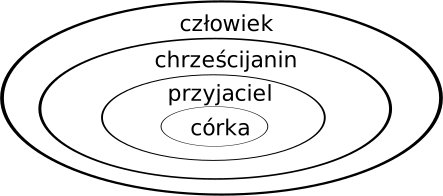
Answers can be really varied. Presentation of what they created.
Was it easy or difficult to determine who you are and arrange it in some order?
What was difficult about it? or
What made it easy to do?
How do I know who I am?
We may have difficulty determining who we are. It happens that we ask someone to tell us who we are, to tell us what they think of us, and in this way we gather information that can help us determine who we are. We also hear how others talk about who they are and try to make our “naming of ourselves” somehow similar, but at the same time original, “ours”.
For the most part, other people give us identity by how they name us. The same was done by parents at our birth -> we were given some name. Then by fulfilling various social roles we were called student, daughter, student, neighbor, etc. (It’s worth also paying attention here to the power of words in naming someone, e.g. if someone constantly tells me that I am stupid, there is a great danger that I will accept it as truth!).
It’s possible that other ideas will come up about where we can know who we are - I think, however, that you will still arrive at the question:
Note
Question-bridge to the next main point
Do people (or something else?), who name us and thereby give us identity, definitely have it right about who we are?
If the need arises:
If we recognize that we ourselves give ourselves identity, do we have certainty that we are not mistaken?
The value of who I am
God - Creator of man:
O Lord, you have searched me and known me!You know when I sit down and when I rise up;you discern my thoughts from afar.You search out my path and my lying downand are acquainted with all my ways.Even before a word is on my tongue,behold, O Lord, you know it altogether.For you formed my inward parts;you knitted me together in my mother’s womb.I praise you, for I am fearfully and wonderfully made.Wonderful are your works;my soul knows it very well.My frame was not hidden from you,when I was being made in secret,intricately woven in the depths of the earth.Your eyes saw my unformed substance;in your book were written, every one of them,the days that were formed for me,when as yet there was none of them.—Ps 139:1-4,13-16
The Lord God is the one who created me. As Creator, He knows best what/who His work is. He also has a proposal for my life (which I can accept or reject), which contains what is best for His unique creation.
The weight of a name:
He who has an ear, let him hear what the Spirit says to the churches. To the one who conquers I will give some of the hidden manna, and I will give him a white stone, with a new name written on the stone that no one knows except the one who receives it.—Rev 2:17
God is also the one who knows me best and who (attention!) has a name for me - unique, intended only for me.
It’s worth recalling here: 1. the weight of names given by the Lord God to various people, e.g. Peter=Rock, Abraham=father of multitude, change of name Saul->Paul; each means something and somehow defines a given person, their mission or task. 2. how the Lord God addressed people in the OT, i.e. directly, BY NAME, e.g. “Samuel, Samuel…”, “Moses…”. This testifies to a real, direct bond between God and those people.
Deepening - the meaning of our names - questions:
Do you know what your name means?
Do you know the history of your name?
Do you know why you were named that?
- Brainstorming:
Let’s see what else the Lord God says about who we are and how He names us. We do a kind of brainstorming on a sheet, i.e. we take a large sheet, write in the middle: “Who am I to the Lord God?”, give each participant one reference to search in Holy Scripture (they can also work in pairs - at the animator’s discretion) along with the instruction to find how we are called in that fragment. Then each reads the quote, says how we are called there, makes an arrow on the sheet from the inscription and writes what they came up with ;)
Illustrative drawing:
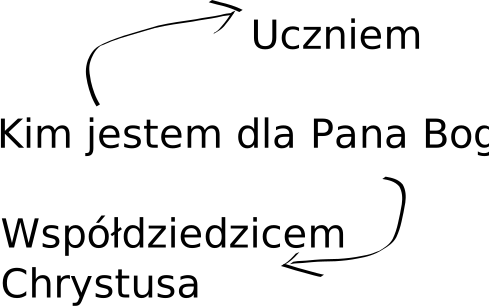
Creativity in implementation is welcome ;). Very important is explaining formulations that may be unclear, e.g. co-heirs with Christ :O. In some references there may be several designations.
No longer do I call you servants, for the servant does not know what his master is doing; but I have called you friends, for all that I have heard from my Father I have made known to you.
—Jn 15:15
Beloved, we are God’s children now,and what we will be has not yet appeared;but we know that when he appearswe shall be like him,because we shall see him as he is.—1 Jn 3:2
Put on then, as God’s chosen ones, holy and beloved, compassionate hearts, kindness, humility, meekness, and patience, bearing with one another and, if one has a complaint against another, forgiving each other; as the Lord has forgiven you, so you also must forgive.
—Col 3:12-13
For all who are led by the Spirit of God are sons of God. For you did not receive the spirit of slavery to fall back into fear, but you have received the Spirit of adoption as sons, by whom we cry, “Abba! Father!”
—Rom 8:14-15
The Spirit himself bears witness with our spirit that we are children of God, and if children, then heirs—heirs of God and fellow heirs with Christ, provided we suffer with him in order that we may also be glorified with him.
—Rom 8:16-17
Then God said, “Let us make man in our image, after our likeness. And let them have dominion over the fish of the sea and over the birds of the heavens and over the livestock and over all the earth and over every creeping thing that creeps on the earth.” So God created man in his own image, in the image of God he created him; male and female he created them.
—Gen 1:26-27
Let’s ask:
Do I like how the Lord God calls me? Why?
Is there something that doesn’t fit me, something I don’t agree with?
Am I ready to recognize that God defines me? (=that He is “greater” than me?)
Warning
Important statement!!!! (the fragments from brainstorming should lead to this!!!): We need to emphasize here that thanks to how the Lord God names us (what we saw above) we gain enormous value -> we are LIKE God!!! We are chosen by Him and important to Him, and we have a task to fulfill = our life has meaning and is to bring much into this world. From these fragments it must result for participants that the Lord God gives value to their existence. And this is value independent of circumstances, situations or random events, nor of whether they do something or not. Their value simply lies in the fact that the Lord God created each of them and wanted each of them.
- Animator’s testimony:
I think this is a very appropriate moment for the animator’s testimony - you will know what about ;) (personally, the topic that one discovers one’s value in relationship with the Lord God suggests itself to me ;); each of us has different experiences, so listen to the Holy Spirit ;)
Conclusion
- Summary:
I am a creation of God; God as my Creator knows best who I am; by allowing Him to enter into relationship with me, and thereby accepting His name for me, I can discover my true value and who I am.
- Leave them with the question:
Do I want the Lord God to be the one who names me? For Him to be the one who defines who I am?
Addendum
A few words from the Catechism on the weight of a name - for your own animator use and development:
203 God revealed himself to Israel, his people, by making his name known to them. A name expresses a person’s essence and identity and the meaning of that person’s life. God has a name; he is not an anonymous force. To disclose one’s name is to make oneself known to others; in a way it is to hand oneself over by becoming accessible, capable of being known more intimately and addressed personally. 204 God revealed himself to his people gradually and under different names, but the revelation made to Moses in the theophany of the burning bush, at the beginning of the Exodus and of the covenant on Sinai, proved to be a fundamental revelation for both the Old and the New Covenant. 205 God calls Moses from the midst of a bush that burns without being consumed: “I am the God of your father, the God of Abraham, the God of Isaac, and the God of Jacob.” God is the God of the fathers, the One who had called and guided the patriarchs in their wanderings. He is the faithful and compassionate God who remembers them and his promises; he comes to free their descendants from bondage. He is the God who, from beyond space and time, can do this and wills to do it. He will reveal his name as “I AM” and he will deliver his people. Moses said to God, “If I come to the people of Israel and say to them, ‘The God of your fathers has sent me to you,’ and they ask me, ‘What is his name?’ what shall I say to them?” God said to Moses, “I AM WHO I AM.” And he said, “Say this to the people of Israel, ‘I AM has sent me to you.’… this is my name for ever, and thus I am to be remembered throughout all generations.” 206 By revealing his name God at the same time reveals his faithfulness which is from everlasting to everlasting, valid for the past (“I am the God of your father”), as for the future (“I will be with you”). God, who reveals his name as “I AM,” reveals himself as the God who is always there, present to his people in order to save them. 207 Faced with God’s fascinating and mysterious presence, man discovers his own insignificance. Before the burning bush, Moses takes off his sandals and veils his face in the presence of God’s holiness. Before the glory of the thrice-holy God, Isaiah cries out: “Woe is me! I am lost; for I am a man of unclean lips.” Before the divine signs wrought by Jesus, Peter exclaims: “Depart from me, for I am a sinful man, O Lord.” But because God is holy, he can forgive the man who realizes that he is a sinner before him: “I will not execute my fierce anger… for I am God and not man, the Holy One in your midst.” The apostle John says likewise: “We shall… reassure our hearts before him whenever our hearts condemn us; for God is greater than our hearts, and he knows everything.” 208 Out of respect for the holiness of God, the people of Israel do not pronounce his name. In the reading of Sacred Scripture, the revealed name (YHWH) is replaced by the divine title “LORD” (in Hebrew Adonai, in Greek Kyrios). It is under this title that the divinity of Jesus will be acclaimed: “Jesus is LORD.”