Meeting 1 — Just as I Have Been Fully Known
Introduction for the facilitator
The first group meeting serves an introductory and integrating function, is a link between other points of Friday - deepens contents from the conference and leads up to evening prayer. Its most important goal is to confront participants with what openness means in practice and share what challenges are associated with such an approach.
At the end of this outline there are materials for printing that will be needed during the meeting!
Introduction
We start with prayer - form according to the animator’s discretion, with particular emphasis placed on the request for openness to each other. If there is a need (participants who do not have experience of sharing meetings in a small group) the animator briefly presents the idea of group meetings and discusses rules. We start by sharing what was born in us while listening to the conference, we start immediately by diving and experiencing the contents of the retreat. Openness involves revealing oneself and readiness to be hurt - in the space of a small group exactly this happens, we do not know each other yet, we know nothing about each other, but we want to awaken openness to each other in ourselves. When answering the questions below, we ask that the person introduce themselves, if someone does not want to answer, let them just introduce themselves.
What contents from the conference resonate most with what has been happening lately in my life?
What perspective on experiencing this retreat did what I heard outline for me?
Do I have a special desire in my heart regarding this retreat?
Open faith
Maciej Biskup OP in one of the entries explained the etymology of the word “Church” (Kościół):
A Church without a heart is a Church-fortress, a fortified castle. Literally this is what the word “kościół” means in Polish, which we adopted from Czech (kostel), and Czech from the Latin word castellum (fortress). Meanwhile from Greek (ekklesia) Church means a convocation of people who do not close themselves in a fortress, but go out to the world with an open heart, to continue to convene, as they themselves were convened.
—”Church that has a heart” from 24.06.2022
What is my experience of the Church?
Which image is closer to me - Church fortress or Church which is a convocation of people going out to the world?
When the Church was sent by Christ to all corners of the world to call everyone to his Name (Mk 16:15), it began to encounter new customs, new cultures, new currents of thought that went beyond the internal world of contemporary Judaism, in which Christianity was born. Every meeting was an opportunity to find common points, to show the universality of Jesus towards everyone as simply as possible (Paul’s speech at the Areopagus - Acts 17:16-34). The environment soaked up the teaching of the Apostles, while new believers combined their heritage with the achievements of the Good News. We see in our times that inculturation, i.e. the entry of the Gospel into the life of different peoples leaves good fruits, but requires strenuous work in “connecting worlds”. As an example we can give different Churches that created their own customs over the centuries:
- Japan
Hidden Christians (Kakure-kirishitan) during two centuries of persecution (XVII-XVIII c.), to maintain the tradition of experiencing the Eucharist, despite the lack of presbyters, used rice and sake to celebrate Thanksgiving at jointly organized liturgies. Currently priests instead of kissing the altar, bow before it in an expression of highest respect.
- Egypt
Christians from the first centuries use the ankh symbol as a sign of life, resurrection. Nowadays it appears on stoles of presbyters and hands of tattooed Christians.
Seeing the beauty of different Churches, we can ask ourselves the question: where was the seed of this wealth? One of the first protagonists of winning people for Christ was St. Paul, called the Apostle of the Nations. He sailed everywhere and to everyone to win many for the Gospel. He admits that to win people he “became all things to all men” (1 Cor 9:20-22). To be one with the other, he consciously made the choice to adapt to the other so that he had a sense of closeness and a bond being created.
How often do I try to walk “in someone’s shoes” and listen to the other side? What is most difficult for me in this?
Have you heard in your life that you can listen or “heard someone”?
When was the last time you stayed with someone longer at the bus stop even though you don’t know this person so well? When did you do 2000 steps for someone instead of 1000? (Mt 5:41)?
Jesus as the One who is open
As we see, the Church from the beginning was more diverse than it may seem to us. Various movements, communities, charisms still permeate and complement each other in it. However, this is not a feature characteristic only for the contemporary Church, because the matter was similar already with Judaism at the time when Lord Jesus taught. Let’s look now briefly at various Jewish factions that existed then.
Note
The animator takes out boards to the center so that every participant of the meeting sees.

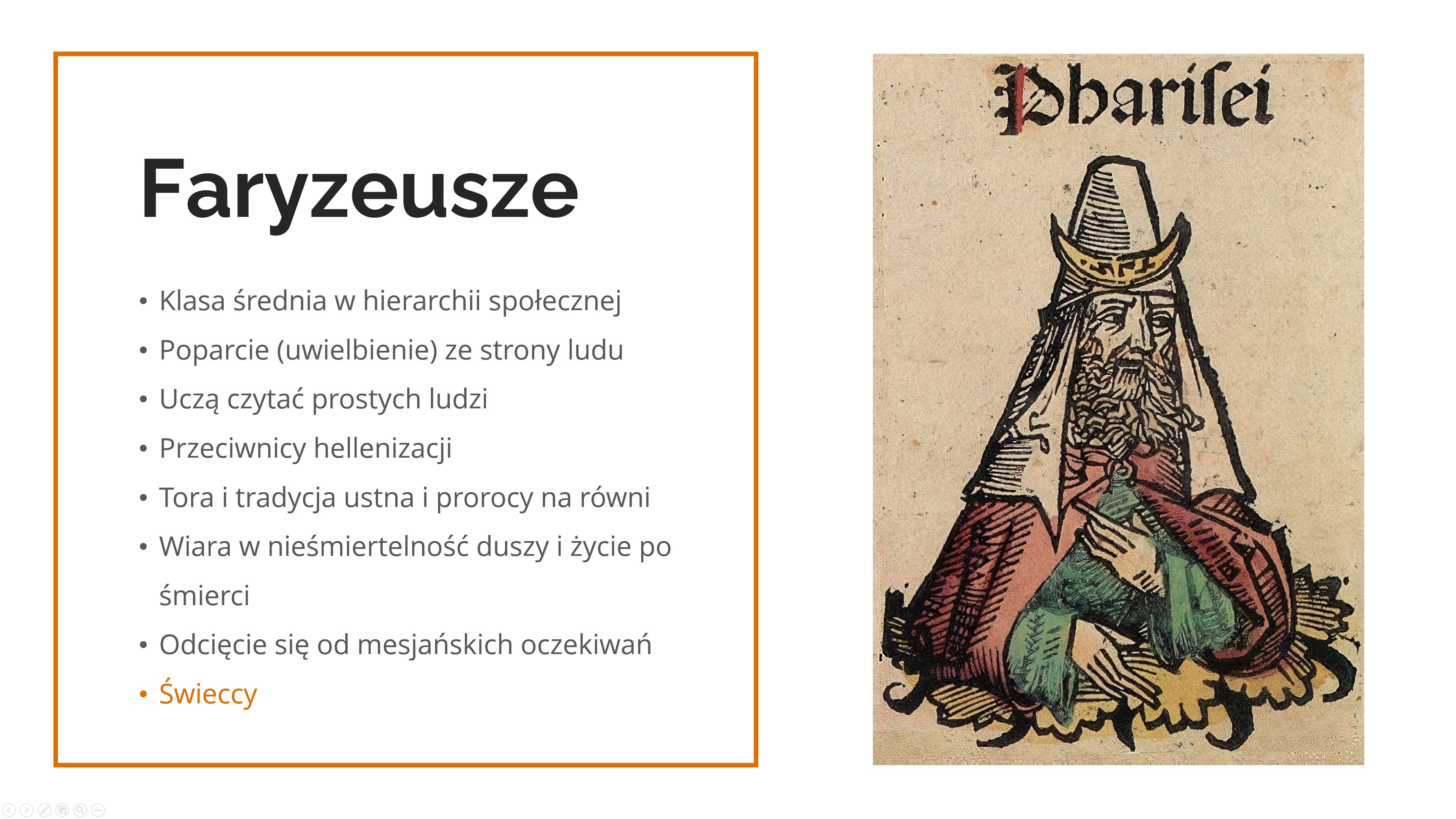
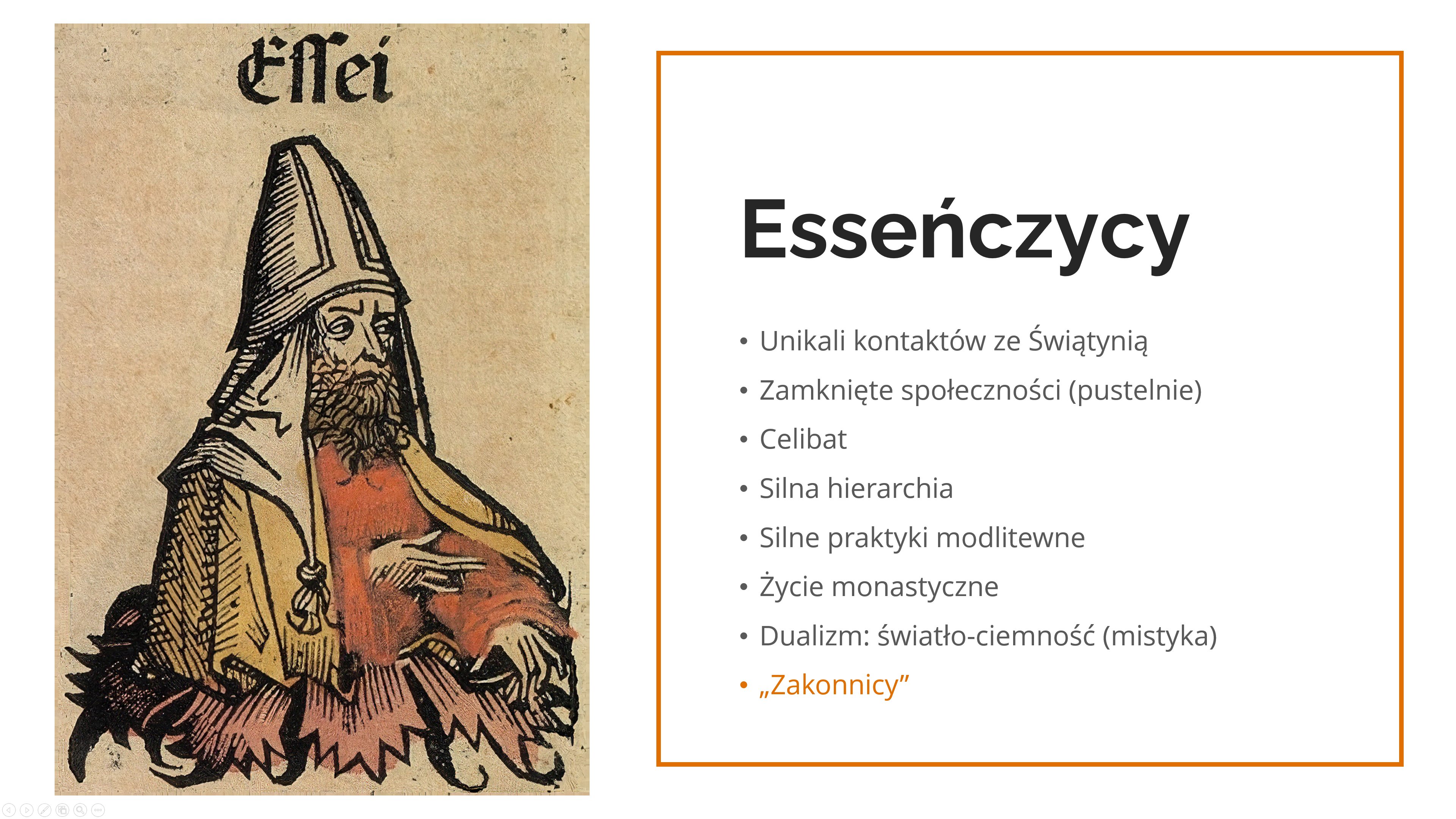
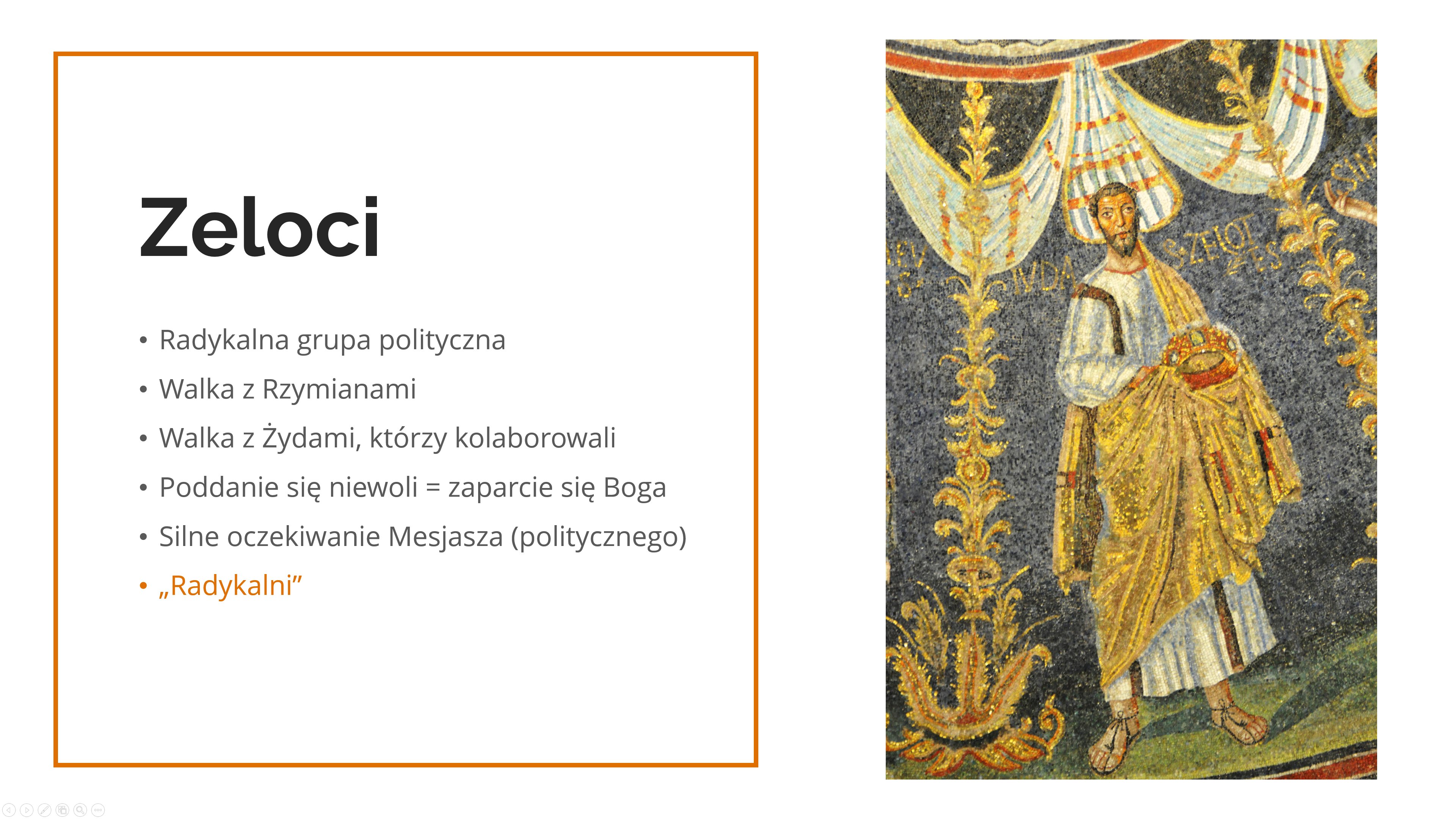
After reading each of the descriptions the animator asks questions:
What reflections were born in me after reading the descriptions of individual factions?
What did Christianity take over from each of them?
Early Christians, just like Sadducees, celebrated the Eucharist themselves, believed in immortality like Pharisees, created communities and mysticism like Essenes, and recognized the essence of personal freedom like Zealots. Openness and drawing from others are inscribed in our faith by Jesus Christ himself. It is assumed that some apostles were representatives of individual factions - the Gospel gives us for example information about Simon, who had the nickname “zealous” - in Greek zelotes, which may indicate belonging to Zealots, similarly Judas is sometimes included in this group. John the Baptist due to the hermit way of life by some sources is considered an Essene, just like his disciples who later followed Jesus. We also know that Nicodemus was a Pharisee.
What similarities do I see between contemporary factions and today’s Church?
The Messiah wanted to have representatives of different views in his closest circle! His openness to others manifested itself also during many meetings described on the pages of the Gospel.
Let’s read now a few example fragments.
Note
Participants of the meeting pair up, each pair gets one of the fragments below and familiarizes themselves with it in silence.
First fragment:
Now when the Lord knew that the Pharisees had heard that Jesus was making and baptizing more disciples than John (although Jesus himself did not baptize, but only his disciples), he left Judea and departed again to Galilee. He had to pass through Samaria. So he came to a city of Samaria, called Sychar, near the field that Jacob gave to his son Joseph. Jacob’s well was there, and so Jesus, wearied as he was with his journey, sat down beside the well. It was about the sixth hour.There came a woman of Samaria to draw water. Jesus said to her, “Give me a drink.” For his disciples had gone away into the city to buy food. The Samaritan woman said to him, “How is it that you, a Jew, ask a drink of me, a woman of Samaria?” For Jews have no dealings with Samaritans. Jesus answered her, “If you knew the gift of God, and who it is that is saying to you, ‘Give me a drink,’ you would have asked him, and he would have given you living water.” The woman said to him, “Sir, you have nothing to draw with, and the well is deep; where do you get that living water? Are you greater than our father Jacob, who gave us the well, and drank from it himself, and his sons, and his cattle?” Jesus said to her, “Every one who drinks of this water will thirst again, but whoever drinks of the water that I shall give him will never thirst; the water that I shall give him will become in him a spring of water welling up to eternal life.” The woman said to him, “Sir, give me this water, that I may not thirst, nor come here to draw.” Jesus said to her, “Go, call your husband, and come here.” The woman answered him, “I have no husband.” Jesus said to her, “You are right in saying, ‘I have no husband’; for you have had five husbands, and he whom you now have is not your husband; this you said truly.” The woman said to him, “Sir, I perceive that you are a prophet. Our fathers worshiped on this mountain; and you say that in Jerusalem is the place where men ought to worship.” Jesus said to her, “Woman, believe me, the hour is coming when neither on this mountain nor in Jerusalem will you worship the Father. You worship what you do not know; we worship what we know, for salvation is from the Jews. But the hour is coming, and now is, when the true worshipers will worship the Father in spirit and truth, for such the Father seeks to worship him. God is spirit, and those who worship him must worship in spirit and truth.” The woman said to him, “I know that Messiah is coming (he who is called Christ); when he comes, he will show us all things.” Jesus said to her, “I who speak to you am he.”—Jn 4:1-26
Second fragment:
He entered Jericho and was passing through. And there was a man named Zacchaeus; he was a chief tax collector, and rich. And he sought to see who Jesus was, but could not on account of the crowd, because he was small of stature. So he ran on ahead and climbed up into a sycamore tree to see him, for he was to pass that way. And when Jesus came to the place, he looked up and said to him, “Zacchaeus, make haste and come down; for I must stay at your house today.” So he made haste and came down and received him joyfully. And when they saw it they all murmured, “He has gone to be the guest of a man who is a sinner.” And Zacchaeus stood and said to the Lord, “Behold, Lord, the half of my goods I give to the poor; and if I have defrauded any one of anything, I restore it fourfold.” And Jesus said to him, “Today salvation has come to this house, since he also is a son of Abraham. For the Son of man came to seek and to save the lost.”
—Lk 19:1-10
Third fragment:
And Jesus went away from there and withdrew to the district of Tyre and Sidon. And behold, a Canaanite woman from that region came out and cried, “Have mercy on me, O Lord, Son of David; my daughter is severely possessed by a demon.” But he did not answer her a word. And his disciples came and begged him, saying, “Send her away, for she is crying after us.” He answered, “I was sent only to the lost sheep of the house of Israel.” But she came and knelt before him, saying, “Lord, help me.” And he answered, “It is not fair to take the children’s bread and throw it to the dogs.” She said, “Yes, Lord, yet even the dogs eat the crumbs that fall from their masters’ table.” Then Jesus answered her, “O woman, great is your faith! Be it done for you as you desire.” And her daughter was healed instantly.
—Mt 15:21-28
After reading in silence each pair briefly tells what their fragment was about. Then the animator asks questions:
What connects all these meetings?
In what did Jesus’ openness towards these people manifest itself?
In contact with others origin, profession, or gender had no meaning for Jesus. Above all he saw a human being, not what they do - regardless of whether someone was a fisherman, tax collector, centurion. Everyone had potential in them, everyone was interesting to Him in some way, he was curious about everyone.
Openness and curiosity
Curiosity is inextricably linked with openness. God is not only fascinated by each of us, He himself is the One who intrigues - appears in a burning bush, pillar of fire or cloud, Jesus with his person arouses interest and astonishment.
What intrigues me personally most in God?
How much curiosity is there still in me about what He is like?
What is my experience of mystery that attracts?
Sometimes we accept in our faith that something is already so obvious, familiar, that the need to ask questions ceases to be born in us. Similarly with the attitude towards people around, we know someone through and through and assume that nothing will surprise us anymore, or in advance we recognize what we can expect from someone. The key to openness is curiosity about the other person and what they can bring to our life.
What helps me in being open?
How often do I show interest to others?
What most often fascinates me in other people?
Let us read at the end:
This fragment comes from the end of St. Paul’s Hymn to Love - at this moment we are not able to either love perfectly, or fully know or understand another human being. However, this does not mean that we should not try. In a moment we will go to evening prayer - let’s not assume immediately what we want to happen at it, as far as possible let’s try to get rid of expectations and simply have openness in us to what God wants to convey to us. Let’s stop and awaken curiosity in ourselves directed both at the One before Whom we will stand, and at people together with whom we will pray. Let’s let ourselves be surprised.
—1 Cor 13:12