Meeting 1. - Faith - Space of Dynamic Turns
Necessary aids
Two markers of different colors, blank sheets of paper (min. 5 pcs.), Holy Scripture, a card with the inscription “RESURRECTION IS MUCH ADO ABOUT NOTHING”, printed graphs (but they can also be created on the fly with the group)
Goal
Obtaining a common ground with participants at the start of the retreat in relation to faith - there is no “closer” and “further”, if faith is grace.
Introduction for the animator to the whole retreat
A meeting with another person starting with the sign of the cross is something that cannot be predicted and which we will never manage to close in the frames of an outline. We stand before the Mystery of another person, their history, desires, experienced situations. Therefore, let these outlines be only an attempt to direct animators to the topic, a certain proposal. “The letter kills, but the Spirit gives life” (2 Cor 3:6) - let these letters scattered on these pages not kill the Spirit of the Meeting, who waits until we invite Him together to dialogue with us.
Introduction for the animator
Since the meeting requires crossing “polite Catholicism”, animators must be sensitized to this, that they must create such an atmosphere of openness from the first minutes of the meeting, so that people feel encouraged and appreciate the value of talking about how it is, and not about how it should be. It is worth saying that this is exactly why we come to the retreat, that we are in such a group where we trust each other, that when someone says something it is not because they do not love God, only because they want to look for answers together with the group. We are touching, in my opinion, some core of what being an animator is. We demand a lot from animators. This is not an outline to be led by reading it like a script. Basically, Saturday I is about what I wrote here, but animators must create such an atmosphere already now. The official moment of transition to this is Fr. Jarek’s homily.
Introduction
The joint introduction will be before the meetings and there will be a lot said about the retreat itself. Here I propose to introduce not so much to the meeting as to the group meeting. Refer to the words from the introduction:
Sometimes when you read a favorite book, or watch a movie, such a simple thought is born: “I would also like to experience something unprecedented, extraordinary in life”. These are good dreams. Let’s try not only to dream but also to act during these three days. Maybe we won’t succeed in being a second Frodo Baggins, Harry Potter or Bella from Twilight, but maybe….. It is exactly this “maybe” that gathered us here….
The retreat has no magic and miraculous powers… but it has a small group :). This is a place where if we trust each other and treat it (and each other mutually) seriously, we will remember it for the rest of our lives. What does seriously mean? Seriously means without bluffing. It does not mean that we have to say everything like in confession, but it means that we want to speak as it is, and not as we would like it to be.
Note
This is the place for the animator’s first testimony (5-7 sentences) regarding what happened when he treated God seriously
Faith is not a monolith
Examples of events from life discovered thanks to various function graphs ;). Participants try to invent themselves what life situation it might be about.
Note
We propose drawing these graphs during the meeting. On the principle “If I drew you something like this, how could you interpret it?”. Such an approach will facilitate your interaction with participants and the meeting will be more dynamic than if you did a slide show for them.
Look at these graphs. Imagine that they illustrate our attitude to various events in our life. Let’s establish that when the graph climbs up it means an increase in interest in a given event (we experience it “more strongly”), analogously when it falls there is a decrease in interest. The graph above the horizontal axis additionally symbolizes that the event in question is important and significant for us. Let’s try, looking at these three graphs, to give examples of three such situations.

when does a feeling of the type “it neither makes me hot nor cold” appear?
- EXAMPLE:
when gasoline gets more expensive, and I don’t have a car; when Greece goes bankrupt and all of Europe wrings its hands - but does it concern me in this small village? ; everyone says something about some economic crisis, that it is the biggest and most burdensome - but what results from this for me, a young person?
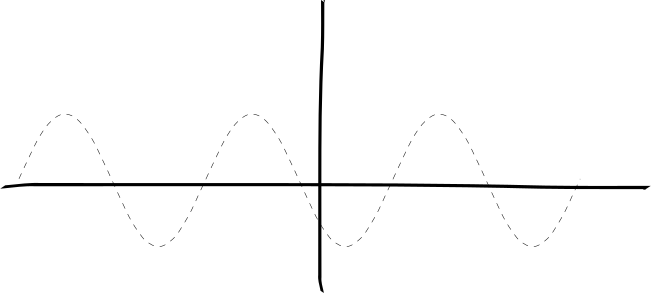
when do I expect something, await something and get something completely different, which disappoints me?
- EXAMPLE:
start in a new school, convincing parents and everyone around like “Well now the real learning will start! You’ll see, it won’t be like before anymore”; building conviction that a new, more important!, stage of life begins; own expectations related to the new situation, new people, duties but also adventures and… confrontation with reality (lack of support from teachers, lack of acceptance among peers, weaker results etc., disappointed expectations regarding school “attractions” etc.)
- EXAMPLE:
a lot of noise related e.g. to the matura exam and simultaneous discouragement of young people: “Matura is nonsense”; “Is your place on earth explained by a passed matura with an A?” versus “What are you worth without matura?”; - I know it’s important but I also have a feeling that it’s just some small step anyway, because what if thanks to it I get into studies, since no one will give me a job anyway? Others ignore matura, go abroad and also live…

when is something important to us, but accompanied by a certain instability?
- EXAMPLE:
Prayer is an extremely important matter for me. However, it is important to me at equal intervals of 7 days and somehow it happens that it is on Sundays at Holy Mass ;).
So we see and realize that in life we perceive important events differently - it is accompanied by indifference, and disappointment, and series of so-called “ups and downs”, and instability, that is things generally not perceived very positively by us, we would say “to be changed”.
Jesus’ story for us is a story of plot twists
And now, keeping these graphs in mind, let’s read a fragment of the Holy Scripture, which also treats about a certain event and people’s attitude towards it.
Now on that same day two of them were going to a village called Emmaus, about seven miles from Jerusalem, and talking with each other about all these things that had happened. While they were talking and discussing, Jesus himself came near and went with them, but their eyes were kept from recognizing him. And he said to them, ‘What are you discussing with each other while you walk along?’ They stood still, looking sad. Then one of them, whose name was Cleopas, answered him, ‘Are you the only stranger in Jerusalem who does not know the things that have taken place there in these days?’ He asked them, ‘What things?’ They replied, ‘The things about Jesus of Nazareth, who was a prophet mighty in deed and word before God and all the people, and how our chief priests and leaders handed him over to be condemned to death and crucified. But we had hoped that he was the one to redeem Israel. Yes, and besides all this, it is now the third day since these things took place. Moreover, some women of our group astounded us. They were at the tomb early this morning, and when they did not find his body there, they came back and told us that they had indeed seen a vision of angels who said that he was alive. Some of those who were with us went to the tomb and found it just as the women had said; but they did not see him.’
—Luke 24:13ff
Did Jesus’ disciples always see great things in him and place faith in him?
Since not, let’s try to trace how it looked over the space of 33 years of his earthly life.
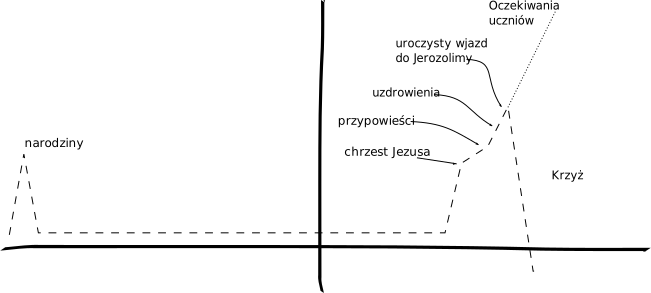
Reception of Jesus’ Life by Disciples before inspiration by the Holy Spirit
Warning
With conversation we try to guide people to see the dynamics presented in the above graph. We draw the above graph (or a better one) “live”, together with participants. Below we present sample auxiliary questions that can serve this purpose.
What does the reception of Jesus by people start with? (Birth!)
Was it something spectacular or something ordinary? (well, angels, Gloria!, star of Bethlehem! There were fireworks)
Ok… so we start with quite a high jump up
And what was afterwards? (Exactly nothing. For 30 years nothing. Only a rascal stayed in the temple, but it wasn’t spectacular)
And after 30 years what happened? (Jesus’ Baptism!)
Was it spectacular? (You bet! A voice from heaven doesn’t happen every day)
etc (animator’s creativity welcome, but let’s not summarize the whole Gospel)
- Conclusion regarding Jesus’ last days before Emmaus:
Jesus tells parables, raises Lazarus, enters Jerusalem solemnly, crowds follow him and a few days later he is mocked and killed. A 180 degree turn of action in a few days, and the story lasted 3 years.
Good disappointment, because it’s a springboard up!
Search:
What connects all these examples and the fragment from the Holy Scripture? What emotions, what feelings? Let’s go back to the last graph.
Where on this graph are the disciples from Emmaus? (animator circles the bottom peak of the graph)
Let’s try to put ourselves in their place, what emotions accompany them? (A sense of disappointment, a sense of meaninglessness with simultaneous awareness of the MOMENTOUSNESS of the event that happened to them, which concerns them, in which they took part.)
There is some space left on it on the right side.
How would you lead the curve further? What is missing on it?
We draw the “resurrection” curve…
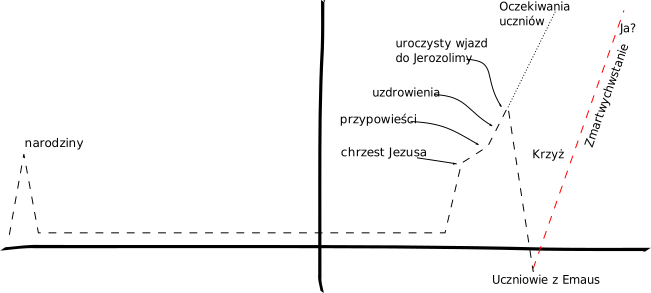
Reception of Jesus’ Life by Disciples knowing the Good News
Intuitively we feel that the graph should go up, but why?
Do we feel that this actually has an impact on us, changes life, renews? Or rather is it accompanied by emotions of boredom, disappointment, discouragement?
We put a card on the table with the words “RESURRECTION IS MUCH ADO ABOUT NOTHING”
And what do you think about this? Do you agree with this? Why yes/no?
And even if we feel ourselves that no, can we say that some think so? Why do they think so?
Conclusions
It is difficult for us to deal with the resurrection. We are aware of the momentousness of this event, someone is constantly quoting St. Paul that “if Christ has not been raised, your faith is futile”; someone is constantly repeating that Easter is the most important holiday for Christians… but do I carry it? Do I accept it? Is it actually important to me? Do I want it? And it is not about answering yes to all these questions now, but to want to stand in truth and realize that I CAN not understand, not accept, not carry, but I should not let go, be indifferent. Each of us feels that his personal faith is something important to him. And for important things it is worth, and even necessary to fight.
Would you like it to look different? Would you like more?
Would you like more strongly?
Would you like stronger and higher?
What do changes start with; what should be our first step? (scream: I don’t want this anymore! I want to get out! I want to live!)
Are you ready to scream like this to a person who will treat this scream very seriously; to Jesus? Because He will answer.
Note
If you are able to, this is the place where you will know what to give testimony about
Application and prayer
At the threshold of this retreat, let us want, richer by what we said to ourselves at this meeting, to ask God in prayer. Let us not be afraid to speak our requests out loud. Let us also remember that forming a small group we also want to remember about each other in prayer.