Meeting 2. - What is a meeting?
Goal
making participants aware that there are meetings and Meetings (with a capital M) and that we, being creators and makers of our life meetings, decide which will prevail
sending them out of the meeting with an attempt to define what a Meeting is
drawing attention to the difficulties and shadows of meetings with others
showing community as a space for meetings, not always easy ones
Meeting aids
drawing pad and writing supplies
two cards with inscriptions “meeting” and “Meeting”
printout of the definition of the word “meet” from the dictionary: http://www.sjp.pl/spotkanie
printout of comic on A4 sheet
printout with examples of various internet dialogues
photos of various meetings
Meetings in everyday life
Lay out on the table several photos showing different meetings (family meeting, date, meeting with friends, visit to a sick person, argument, business meeting, meeting of John Paul II with Ali Agca and two photos showing a meeting online). Participants try to find a common theme for all photos – MEETING.
A loose but brief conversation with participants about meetings in everyday life.
Warning
This point serves mainly to introduce the topic, to make aware that life is a series of meetings, more or less meaningful for us, easier, more pleasant and more difficult, painful, etc. The conclusion the conversation should lead to is: WE OURSELVES ARE THE CREATORS OF OUR MEETINGS - maybe we don’t always decide about the fact of meeting, but we certainly always have an influence on their shape, atmosphere, etc.
Meetings in real life vs. meetings in virtual space
A specific type of meeting, typical for us living in the internet age, are meetings online: on chats, messengers, social networks, etc.
Provocative question: Are online meetings valuable?
Probably someone will answer that they’re not, or at least will be inclined to argue that these are valuable meetings. And if not, you can always fall back on the statement that “the Internet is often criticized because people hide their true selves there, don’t tell the truth, talk about stupid things because well ‘today’s youth…’ etc.). We’re heading towards starting a conversation on this topic not from the classic ‘Internet trivializes relationships’ (although that’s true…), virtual is evil, etc., but in a positive way, saying that online meetings can be good and valuable because after all we decide how they look. BUT…
…the fact that they can be such doesn’t mean they always are. Usually, however, the rules that govern the network (anonymity, lack of direct contact, emoticons instead of emotions, etc., ease of misunderstandings) lead to these MEETINGS BEING QUITE STERILE, NOTHING BRINGS TO OUR LIFE, AND THEIR MULTITUDE LEADS TO US QUICKLY FORGETTING THAT THEY WERE.
Let’s visualize this – we choose two people, each of them gets a card with an example of a common internet dialogue. We seat them opposite each other and ask them to read the dialogue. And a second example – we cut the story from the attachment into pieces, participants arrange it together. Or just present it in full – as you prefer.
Then we ask participants about their experiences related to this type of “meetings” (I suspect they may want to argue, then you need to take it up bravely and God forbid not deny, but only gently make it understood that a meeting online is not the pinnacle of interpersonal meetings in general). Questions:
How many conversations did I have online last week?
How many of them could I give a topic like “conversation about movie XYZ”?, “hi, what’s at school” etc.?
How often do I have “conversations” in the style of those presented earlier?
We conduct a brief comparison of meetings in real life and meetings in virtual space. We’ll do this in 2 stages:
- STAGE 1: - Preparation for these meetings:
How do we prepare for a meeting in real life and how for a meeting online and how does it proceed? - this can be written down on a card during conversation with participants (meeting in real life - care for outfit, makeup, (who among us doesn’t look in the mirror when going out to meet another person?), importance of gestures (have you ever practiced in front of a mirror before an important meeting for you, maybe a date?), eye contact, certainty that we’re going to meet a living person; maybe an attempt to give that person some small pleasure like flowers or some gift? meeting online – I can look however I want, I can write whatever I want, I can leave whenever I want and write back soon, maybe silence will fall and no one will be embarrassed, I don’t have to focus on this meeting - I can simultaneously write with someone and read information online)
How do we view the value of these meetings in connection with this? How does their comparison turn out?
- STAGE 2 – The course of these meetings:
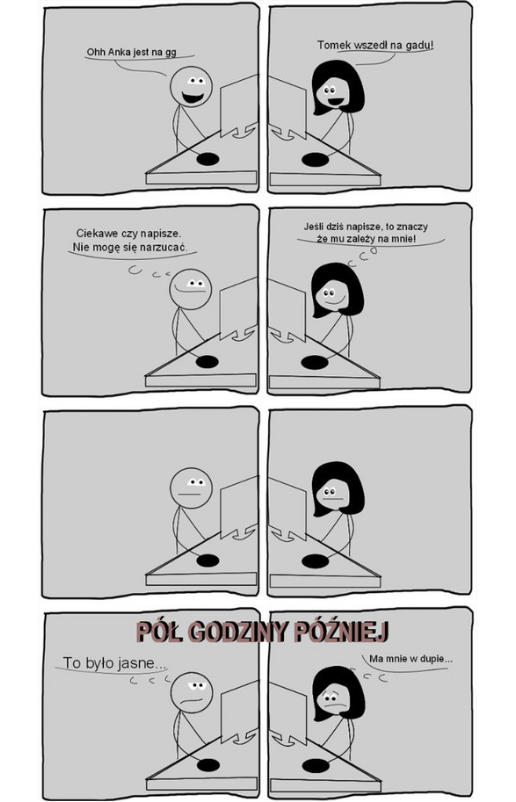
Comic - The comic illustrates how online it’s easy to misunderstand, how you can misread someone’s words, someone’s behavior or precisely its absence
You can pull the topic a bit with participants: Do they know this from somewhere, do they agree, etc. But mainly it’s about getting them to think about how this meeting could look if they were sitting opposite each other, if this monitor didn’t separate them. You can suggest they prepare short scenes illustrating such a meeting e.g. in different places (cafe, park, bus stop) – and encourage them to think about what they certainly couldn’t experience online. Conclusion - MEETINGS IN REAL LIFE BECAUSE THEY PROVIDE DIRECT CONTACT WITH ANOTHER PERSON CAN GIVE US MORE EXPERIENCES, STICK MORE IN OUR MEMORY AND THUS HAVE GREATER MEANING FOR US. THEY ALLOW US TO AVOID DISAPPOINTMENTS CAUSED BY INTERNET UNCERTAINTY AND THE NECESSITY OF GUESSES AS WELL AS MISUNDERSTANDINGS RELATED TO INCORRECT READING OF SOMEONE’S WORDS OR INTENTIONS.
Quality of meetings in real life
It’s worth asking ourselves now about the quality of our meetings in real life - how we experience them, how they look, etc.
What do you do when you meet with friends - write down 3 activities that always occur, regardless of which friend it is, which place, etc. (I suspect that “talking” will be repeated many times…)
…we continue the topic considering this issue - how do the words “meeting” and “talking” relate to each other (they rhyme! :D).
Is it easier for us to speak or to listen?
Do we treat meetings as an opportunity to talk ourselves out?
Can we imagine for a moment a meeting without talking?
Does it lose value because of this? Why yes/no?
Looking for meetings where there’s no talking (examples: two fishermen fishing, keeping vigil by an unconscious person). And maybe participants already have such a meeting in their experience?
Curiosity - saying: Lord, save me from the harmful habit of thinking that I must say something on every topic and on every occasion.
…and continuing the topic about the quality of meetings, another issue: In whose name do we meet? (for ourselves, e.g. so as not to feel alone, for others - so they don’t feel alone, because we have some interest) - you can use photos from the beginning of the meeting. Which meetings prevail? How do I feel – which of them bring more into my life? Why?
The issue of meetings and Meetings
At this point it’s worth touching on the topic of meetings and Meetings

Note
cards with these words written in an appropriate way for visualization we lay out on the table
After everything we’ve said, can we establish some definition of these two words, seemingly similar, but different? How does a meeting differ from a Meeting? Help towards this will be…
…presenting the definition of meeting from an online dictionary (http://www.sjp.pl/spotkanie) presented in 4 points:
meeting1. to come across someone or something, to see someone;2. to get to know someone;3. to find something somewhere;4. to happen, to become someone’s lot
This definition is interesting in that it presents a certain path that divides meeting and Meeting, fills the space between them. A meeting can be “coming across someone”, it can include “seeing someone”. This can result in “getting to know someone” and “finding through meeting something good, valuable e.g. in a person or in a situation, and maybe in oneself”. Finally, a meeting can lead to “something happening”, that “something becomes our lot”, in other words, that something changes in our life as a result of the meeting, someone becomes for example part of us thanks to the meeting, or we become part of someone’s world, and best if both :) Analysis of this definition together with participants should result in outlining what we understand by the word “meeting” and “Meeting” and the difference between these two events.
However, does the fact that a meeting can have such 2 dimensions mean that we should only await those second, objectively more valuable ones? How do the ones relate to the others?
The point is that meetings are the path to Meetings, sand among grains in which we search for pearls. Examples: We come every week to Holy Mass to experience a mystical experience once every six months….We drink beer after work with buddies, among other things so that when THAT MOMENT comes, to stop it with a manly conversation before breaking up one’s own family, etc.
- Summary of this part:
Meetings are different, the fact is they fill our life. I have a huge influence on the quality and shape of my meetings with others. Much can depend on the decision about the fact of meeting, there are Meetings that can change much.
Meeting as a space of difficulty
We return to photos with examples of meetings from the beginning. The task for participants is to think according to what criterion these meetings can be divided - it’s about difficult and pleasant meetings. If they don’t come up with it, we take one photo with a pleasant meeting and one with a difficult one placing them as if in opposition to each other - then they should get it:P
After dividing photos it comes out basically half and half; a business meeting and an online meeting can be classified differently, but that’s not important. We’re heading towards the topic of “difficult meetings” - for what reasons can these meetings be difficult (negative emotions, stress, fear, necessity of forgiveness)? what does it mean that they’re difficult, why do we perceive them this way? can these meetings be in some way valuable or are they only a source of sadness, pain, irritation, etc.?
Community as meeting
Now we’ll move on to considering the issue “Community as a space for meeting” (because our retreat is about community) - what meetings do we deal with in community? what can we say about them? perhaps some already have some experience - let them tell about their meetings in a community context.
Warning
A witness from the animator is needed here!
What is the most important feature of meetings in community, what distinguishes them from meetings in other spaces (at school, at work) - THERE IS NO COMMUNITY WITHOUT MEETINGS WITH A CAPITAL M. If they don’t exist then we’re dealing with a group, where many meetings do occur, perhaps valuable in the eyes of those who take part in them…But in community it’s different - over time you notice that this place is filled with Meetings - which change, which build, for a long time and I dare say, even forever.
But let’s leave our communities for now, present ones, and think about communities from Jesus’ times. Which one first comes to mind? (it’s obviously about the Apostles). What is our knowledge now about this community - what kind of community were the Apostles? (I suppose most answers will be positive descriptions…and if not then we ourselves head towards presenting them in such light. Apostles as a community of harmonious people, holy people after all!, undertaking common effort and cooperation to achieve common goals, deeply believing people, etc.)
And then slowly…can we say with complete certainty that they were a community to which only positive descriptions fit? did they live pleasantly and harmoniously, at all times? Did Jesus’ closeness among them act as protection against sin, doubt? Well, Jesus knew that among the apostles it wasn’t always pleasant and harmonious, he also knew that after His death it wouldn’t be so either, and yet He desired this community!
To confirm that in the apostles’ community things varied, let’s look at 3 stories. THIS HAS A DUAL PURPOSE - TO DRAW ATTENTION TO CONFLICT SITUATIONS AND DIFFICULTIES, BUT AT THE SAME TIME TO SHOW WAYS OF DEALING WITH THEM, WAYS OF FUNCTIONING OF PARTICIPANTS IN DISPUTE - conflict in these stories is a contribution to showing ways of dealing with it. (the way of “looking at” these stories is to be considered - either we all work on one text or we divide into groups and each works on one. But it seems to me that everyone should work on one….)
Let’s read:
They came to Capernaum. When he was in the house, he asked them, “What were you arguing about on the road?” But they kept quiet because on the way they had argued about who was the greatest. He sat down, called the Twelve and said to them, “If anyone wants to be first, he must be the very last, and the servant of all.”
—Mk 9,33-34
This whole situation resulted from the fact that a desire to dominate, to be noticed or appreciated by Jesus, to gain recognition maybe also in the eyes of other apostles “came out” of the apostles. Notice how human this is, how close to us too - who among us doesn’t have such needs, to be praised, noticed, to be distinguished from others? Apostles were ordinary people…and conflicts of this kind were not foreign to them either. But we read that they “kept quiet”, they knew they behaved stupidly, immaturely, unwisely and Jesus knows this too by teaching them later. They recognized their weakness and stopped the quarrel.
When Cephas came to Antioch, I opposed him to his face, because he stood condemned. For before certain men came from James, he used to eat with the Gentiles. But when they arrived, he began to draw back and separate himself from the Gentiles because he was afraid of those who belonged to the circumcision group. The other Jews joined him in his hypocrisy, so that by their hypocrisy even Barnabas was led astray. When I saw that they were not acting in line with the truth of the gospel, I said to Cephas in front of them all, “You are a Jew, yet you live like a Gentile and not like a Jew. How is it, then, that you force Gentiles to follow Jewish customs?”
—Gal 2,11-14
Paul speaks sharply in the letter. He’s very angry at Peter - at the one who was chosen, distinguished from the twelve. What could Peter think to himself - that this one who only recently converted will teach him? Him, who knew Jesus personally and to make matters worse was chosen by him as the leader of the Church? Oh no! But…he accepted these accusations, it turned out Paul was right, at the council they sided with his position. He was able to accept criticism.
Some time later Paul said to Barnabas, “Let us go back and visit the brothers in all the towns where we preached the word of the Lord and see how they are doing.” Barnabas wanted to take John, also called Mark, with them, but Paul did not think it wise to take him, because he had deserted them in Pamphylia and had not continued with them in the work. They had such a sharp disagreement that they parted company. Barnabas took Mark and sailed for Cyprus, but Paul chose Silas and left, commended by the brothers to the grace of the Lord.
—Acts 15,36-41
A prosaic dispute. But it’s worth emphasizing here how Paul and Barnabas got out of this - sometimes it’s better to part ways, so as not to inflame the situation. There was a conflict, “the dispute sharpened” but they didn’t kill each other out of anger - they found a solution.
- WE’RE HEADING TOWARDS A CONCLUSION…
These situations make us aware that the Apostles were not perfect. But also that we today as members or future members of communities won’t be such either. And that’s not the point at all. The point is TO REALIZE THIS AND ACCEPT IT. Conflicts and difficulties indeed cause various painful matters, taking offense, conviction that I’m no longer able to find a common language with someone. But in these stories Jesus also leaves us hints on how to deal with what is after all an inevitable element of our meetings.
And really, paradoxically, we need to rejoice that something is happening, that it’s good, but also that it’s sometimes difficult and painful - Why? - Because there is life there, real, not sugar-coated. Sometimes you need to quarrel to really meet, to learn something about yourself and others. Sometimes it must hurt - because after all power is perfected in weakness, although it sounds strange in human terms. But to learn such joy you need to convince yourself that difficult meetings, also in community, are not a punishment from the Lord God, but a lesson for each of us and a step towards maturity - life and Christian.
We gather contents from the whole meeting into a whole (you can use the previous summary and glance at the meeting goals and formulate a few words for conclusion according to them). I recommend ending with a round, oral or written, encouraging participants to answer the question “What do I end this meeting with?”