Meeting 2 - Sympathizers or Christians?
Meeting Goal
At this meeting, the key is to emphasize the issue of fidelity, that only persistent and faithful commitment brings good fruit.
Participants should leave with the conviction that one cannot be a Christian half-heartedly. Either you are one, or you are not.
The meeting leads up to the evening prayer and it depends on it how the participants will experience it.
Introduction for the Animator
Probably it won’t be a discovery, but in this meeting the key moment is to be the animator’s testimony. Life is born from life, so if participants do not see an example of someone who takes Christianity seriously and devotes themselves completely to it, long fragments from the Holy Scripture or other wise books will not convince them.
Baptism gives a certain chance, a certain possibility, but without human effort it can remain dead in man, not reveal any effects.
—Fr. Franciszek Blachnicki
Initial Prayer
Note
5 minutes
Prayer to the Holy Spirit for help in keeping fidelity to God.
Introduction to the Meeting
We are after the conference and homily, where we heard that faith is not a matter of upbringing, that it is our decision in which we must persist and for which we must fight. However, what does this mean? What is the meaning of our “believing” and how to care for this gift, which is faith?
Passions
Note
30 minutes
Let’s start by asking a few questions:
What is passion?
What characterizes a person with passion?
What passions do you have? What are you interested in? What gives you the greatest joy and satisfaction?
Most people have some passion. Something they care about, to which they devote a lot of time, to which they return with pleasure.
What for? Why bother? Why devote a lot of time to something from which there are usually no benefits? What are the reasons and what is the goal?
Can faith be a passion?
Among people in the Holy Scripture, we meet many people for whom faith was their greatest passion, for which they were able to sacrifice a lot.
Let’s read:
Noah was a righteous man, blameless in his generation. Noah walked with God. And Noah had three sons, Shem, Ham, and Japheth. Now the earth was corrupt in God’s sight, and the earth was filled with violence. And God saw the earth, and behold, it was corrupt, for all flesh had corrupted their way on the earth. And God said to Noah, “I have determined to make an end of all flesh, for the earth is filled with violence through them. Behold, I will destroy them with the earth. Make yourself an ark of gopher wood. Make rooms in the ark, and cover it inside and out with pitch. For behold, I will bring a flood of waters upon the earth to destroy all flesh in which is the breath of life under heaven. Everything that is on the earth shall die. But I will establish my covenant with you, and you shall come into the ark, you, your sons, your wife, and your sons’ wives with you. And of every living thing of all flesh, you shall bring two of every sort into the ark to keep them alive with you. They shall be male and female. Of the birds according to their kinds, and of the animals according to their kinds, of every creeping thing of the ground, according to its kind, two of every sort shall come in to you to keep them alive. Also take with you every sort of food that is eaten, and store it up. It shall serve as food for you and for them.” Noah did this; he did all that God commanded him.
—Gen 6:9-14.17-22
What guided Noah?
Why did he do it?
What could have been the reactions of his surroundings to the fact that he was building a huge ship on dry land? (laughter, misunderstanding, rejection?)
We often encounter that our passions (both interests and faith) are misunderstood by our surroundings. People do not see the sense of what we do, try to pull us away from it, sometimes ridicule.
How do I behave in such a situation? (here should appear some mention of difficulties and discouragement)
What am I able to sacrifice for what is important to me? What examples of difficult choices from my life do I remember when I had to give something up (‘theoretical’ life priorities vs. actual commitment, devoted time and energy)?
Let’s look at other figures who were able to sacrifice a lot for what they believed in.
Individual work: participants receive cards with a biblical fragment/short description of the character and questions to the text. Everyone (including the animator) thinks about the given person, after which we present our thoughts in the forum and look for common features. There are 4 examples, so they will repeat. Remember to print texts for everyone.
- Peter and John (Acts 4:13-21)
Now when they saw the boldness of Peter and John, and perceived that they were uneducated, common men, they were astonished. And they recognized that they had been with Jesus. But seeing the man who was healed standing beside them, they had nothing to say in opposition. But when they had commanded them to leave the council, they conferred with one another, saying, “What shall we do with these men? For that a notable sign has been performed through them is evident to all the inhabitants of Jerusalem, and we cannot deny it. But in order that it may spread no further among the people, let us warn them to speak no more to anyone in this name.” So they called them and charged them not to speak or teach at all in the name of Jesus. But Peter and John answered them, “Whether it is right in the sight of God to listen to you rather than to God, you must judge, for we cannot but speak of what we have seen and heard.” And when they had further threatened them, they let them go, finding no way to punish them, because of the people, for all were praising God for what had happened.
- Moses (fragment with the burning bush)
Now Moses was keeping the flock of his father-in-law, Jethro, the priest of Midian, and he led his flock to the west side of the wilderness and came to Horeb, the mountain of God. And the angel of the Lord appeared to him in a flame of fire out of the midst of a bush. He looked, and behold, the bush was burning, yet it was not consumed. And Moses said, “I will turn aside to see this great sight, why the bush is not burned.” When the Lord saw that he turned aside to see, God called to him out of the bush, “Moses, Moses!” And he said, “Here I am.” Then he said, “Do not come near; take your sandals off your feet, for the place on which you are standing is holy ground.” Come, I will send you to Pharaoh that you may bring my people, the children of Israel, out of Egypt.” But Moses said to God, “Who am I that I should go to Pharaoh and bring the children of Israel out of Egypt?” He said, “But I will be with you, and this shall be the sign for you, that I have sent you: when you have brought the people out of Egypt, you shall serve God on this mountain.” Then Moses said to God, “If I come to the people of Israel and say to them, ‘The God of your fathers has sent me to you,’ and they ask me, ‘What is his name?’ what shall I say to them?” But behold, they will not believe me or listen to my voice, for they will say, ‘The Lord did not appear to you.’” The Lord said to him, “What is that in your hand?” He said, “A staff.” And he said, “Throw it on the ground.” So he threw it on the ground, and it became a serpent. But Moses said to the Lord, “Oh, my Lord, I am not eloquent, either in the past or since you have spoken to your servant, but I am slow of speech and of tongue.” Then the Lord said to him, “Who has made man’s mouth? Who makes him mute, or deaf, or seeing, or blind? Is it not I, the Lord? Now therefore go, and I will be with your mouth and teach you what you shall speak.” But he said, “Oh, my Lord, please send someone else.” Then the anger of the Lord was kindled against Moses and he said, “Is there not Aaron, your brother, the Levite? I know that he can speak well. Behold, he is coming out to meet you, and when he sees you, he will be glad in his heart. You shall speak to him and put the words in his mouth, and I will be with your mouth and with his mouth and will teach you both what you shall do. He shall speak for you to the people on your behalf, and he shall be your mouth, and you shall be as God to him. And take in your hand this staff, with which you shall do the signs.”
- St. Teresa Benedicta of the Cross (Edith Stein)
Edith Stein was born into a large but wealthy Jewish family in Wrocław. She was the youngest of eleven children. Her father died when she was only two years old, from then on her mother took care of both the children and her late husband’s company. Despite the lively faith of the whole family, and especially her mother, at the age of 14 Edith declared that she was an atheist. She studied German studies and history at the University of Wrocław. From 1913 she studied in Göttingen under the supervision of Edmund Husserl. She wrote and defended her doctoral dissertation On the Problem of Empathy under him. Through one of her acquaintances, she came into closer contact with Catholicism. After the death of her good friend, she was supposed to fall into apathy and spiritual tornness. Under the influence of the widow of her friend, an Evangelical, she began to experience conversion, which finally happened when she read the biography of St. Teresa of Avila. On January 1, 1922, she was baptized in the Catholic Church, taking the name Teresa. Her faith is deepened while studying, among others, the works of Saint Thomas Aquinas. On October 13, 1933, she said goodbye to her family (her mother never reconciled with the decisions of both Edith and other children). The next day she entered the Carmel in Cologne and took the name Teresa Benedicta of the Cross. She chose St. Teresa of Avila and St. John of the Cross as her spiritual guardians. In the face of increasing persecution of Jews, on December 31, 1938, she was transferred to the Carmel in Echt in the Netherlands. Four years later, on August 2, 1942, she was arrested by the Gestapo, along with other Catholics of Jewish origin, including consecrated persons. At the time of the arrest, she was supposed to say to her sister, Rosa: Come, we are going to suffer for our people. The prisoners were first imprisoned in the Westerbork transit camp in the northern Netherlands. She was last seen on August 7 at the main station in Wrocław during a stop of the train taking her along with other Jews to the camp in Auschwitz. Probably on August 9, she was gassed in the German extermination camp KL Auschwitz II-Birkenau.
- St. Francis
Francis was born into the family of a wealthy merchant. He spent the first years of his life in Assisi. He attended the parish school at the church of St. George, where he received basic education. At the age of 21, he took part in the war between Assisi and Perugia. At the turn of 1202 and 1203, as a result of a companion’s betrayal, he was imprisoned in Perugia. Released in 1204, due to serious illness he returned to Assisi. The year 1205 is the beginning of the slow process of Francis’s conversion. During a war expedition to Apulia, in Spoleto he had a vision that decided the course of his life. Due to the recurrence of the disease, he returned to Assisi again, where he generously gifted a leper met on the way and gave him a kiss of peace. In the Assisi church of San Damiano in the autumn of the same year, he heard the voice of Christ speaking from the icon of the cross, which told him to go and rebuild the church. Repairing the church, he sold a horse and took several bales of cloth from his father’s shop, which led to a conflict with him. The father first imprisoned him, and then, in 1206, took him before the bishop’s court (at Francis’s request, who believed that no other tribunal was authoritative for him). The bishop ruled that Francis should return the costs to his father, to which Francis declared that he had no father – he took off his clothes, remaining in a hair shirt alone, folded them and together with the money gave them to his father. He began a life of penance, among other things assisting in a leprosarium. In the spring of 1209, Francis asked in Rome for approval of the religious rule he had written. In 1224 he received the holy stigmata. Terrible pain pierced him, and when he woke up, he saw that his feet and wrists were pierced with nails, and his side open. In 1225 Francis began to feel more and more ailments associated with eye disease. At the persuasion of Brother Elias, he underwent ineffective medical treatments. He spent the last months of his life traveling from city to city. At the end of the summer of 1226, he returned to Assisi. He died, laid at his own request without clothes on the bare ground, on Saturday, October 3, 1226.
Questions:
What did this person do? In what did their passion manifest itself?
Did they encounter any difficulties? What kind?
How did they behave in this situation?
Where Is the Problem?
Note
10 minutes
Each of these people encountered some adversities on their way, but they always managed to overcome them in some way. History is full of such people for whom faith was the most important value in life and who were able to sacrifice everything for it. However, they are not super heroes, people without any flaws who never doubted and never suffered defeat. Chapter 11 of the Epistle to the Hebrews speaks about this.
Note
At this point, I advise giving participants a minute to browse this chapter, see what it is about, read a few random verses to gain a general picture. I do not recommend reading it aloud, let them do it as an application from the meeting. The animator’s commentary and interpretation are important, for example based on the text below. The animator should of course read this entire fragment before the meeting.
As Archbishop Fulton Sheen writes:
When the temptation to fall into despair overwhelms us, it is worth looking into the 11th chapter of the Epistle to the Hebrews, which is a catalog of Old Testament saints. It is worth reviewing this catalog from time to time. And then let’s read about the lives of these Old Testament men and women. They were all like brands plucked from the burning. Noah: got drunk after the flood. Abraham: God told him to leave the country with his wife Sarah, and he took his nephew and his wife, about whom God did not mention taking, and they caused him trouble. Then he went to Egypt during the famine instead of trusting God, then he sinned with Hagar and Ishmael was born from this relationship. Despite this, Abraham is praised for his faith as many as eleven times in just one chapter of the Epistle to the Hebrews. Moses killed a man. Samson, an adulterer, broke his Nazirite vows. Barak, a general, did not want to go to war unless a woman, Deborah, joined him so that he could rely on her military judgment. And so on, and so on. In the Old Testament, they seemed to be completely different people. God chose them not guided by what they were, but by what they could become. That is why he chose us: we are His tools. God’s power is revealed in what He can do with a fragile reed.
God does not call the qualified, but qualifies the called!
I propose to write this sentence on a large sheet of paper and ask participants for statements on this fragment of the meeting.
Do you agree with this?
Do you have similar experiences? What kind?
What Do I Want to Change? Who Do I Want to Be?
Note
5 minutes
We also encounter various difficulties on our way. Everyone has their own way of dealing with them. However, one cannot give up and recognize “I am hopeless, nothing works out for me, I am good for nothing”, but find the cause that it does not work out, that it is bad.
Sometimes we look for the cause of our failures in a completely wrong place. I always wanted to play the violin, it doesn’t work out for me, why? Not because I have crooked fingers, but maybe I practice too little, I get discouraged too quickly, I don’t feel like practicing scales, but immediately I would like to play Vivaldi? And maybe I have good fingers and even practice a lot, only the problem lies in the fact that I try to play parts intended for the trumpet?
Let’s wonder (without sharing):
What did I have a problem with recently? What didn’t work out for me? Why did I get discouraged?
What could have been the cause of this?
Do I see more such situations in my life?
Fidelity
Note
10 minutes
Note
This part of the meeting has the character of storytelling by the animator. It is worth doing it in the form of a conversation.
One of the basic conditions for achieving success and satisfaction is fidelity to what one does. Just as I will not learn to play the violin without tedious practice of boring scales, so I will not learn to pray the Tent of Meeting without many hours over the Holy Scripture when it seems to me that it makes no sense.
Fidelity is not easy. It is always easier to give up something that is difficult for us than to persist in our decision. This is the place for testimony about fidelity. Fidelity to another person, fidelity to one’s decisions, fidelity to one’s interests, fidelity to the mystery, fidelity to prayer, finally fidelity to God himself.
Lack of fidelity and perseverance leads to softening. We start “jumping from flower to flower”, we don’t like anything, we don’t engage in anything 100%, everything seems gray and boring. Our life slowly becomes shallow and loses meaning.
Warning
A difficult moment, but very important. Do not skip this because of a few difficult words and concepts. Instead, make sure that participants, especially the youngest ones, understood what it is about. Let’s not lower the bar. Let’s explain to everyone what moral relativism and objective truth are, it is incredibly important in the life of every human being. And please do not read these elaborations to the participants, just prepare nicely and say it from the heart ;).
Nowadays, views are propagated that objective truth does not exist, that life is a scale of grays, not black and white choices. Moral relativism reigns and the view that “everyone has their own truth”. The concepts of tolerance and freedom of speech are distorted when within the framework of these concepts the dignity of another human being is violated. Let’s not let ourselves be told that there is no good or evil, and the truth lies in the middle.
In my opinion, moral relativism is the greatest threat to young people today. We very often hear that everyone has the right to their own opinion. Yes, they have the right, provided that it is not based on falsehood. If person “A” claims that red dresses are prettier than blue ones, and person “B” that it is the opposite, then everything is fine. However, if person “A” claims that 2+2=5, and person “B” that 2+2=4, it means that person “B” is right, and person “A” is wrong. The truth does not lie in the middle, person “A” has no right to their own opinion. The fact that 2+2=4 is simply an objective truth. Similarly with moral values. Something is either good or bad. Evangelical radicalism consists in a clear distinction of one from the other, in other words, not deceiving oneself.
—Bartek Szaraniec (http://szara.jezuici.pl/)
Let’s read:
See, I have set before you today life and good, death and evil. If you obey the commandments of the Lord your God that I command you today, by loving the Lord your God, by walking in his ways, and by keeping his commandments and his statutes and his rules, then you shall live and multiply, and the Lord your God will bless you in the land that you are entering to take possession of it. But if your heart turns away, and you will not hear, but are drawn away to worship other gods and serve them, I declare to you today that you shall surely perish. You shall not live long in the land that you are going over the Jordan to enter and possess. I call heaven and earth to witness against you today, that I have set before you life and death, blessing and curse. Therefore choose life, that you and your offspring may live, loving the Lord your God, obeying his voice and holding fast to him, for he is your life and length of days, that you may dwell in the land that the Lord swore to your fathers, to Abraham, to Isaac, and to Jacob, to give them.
—Deut 30:15-20
God himself says that the choice is only between good and evil, that there are no intermediate things, something like “a little death” or “light curse”.
Note
You can also add Mt 5:37: Let what you say be simply ‘Yes’ or ‘No’; anything more than this comes from evil.
Sympathizers or Christians?
Note
20 minutes
In the Gospel according to St. Mark, we read the story of someone who faced a similar choice:
And as he was setting out on his journey, a man ran up and knelt before him and asked him, “Good Teacher, what must I do to inherit eternal life?” And Jesus said to him, “Why do you call me good? No one is good except God alone. You know the commandments: ‘Do not murder, Do not commit adultery, Do not steal, Do not bear false witness, Do not defraud, Honor your father and mother.’” And he said to him, “Teacher, all these I have kept from my youth.” And Jesus, looking at him, loved him, and said to him, “You lack one thing: go, sell all that you have and give to the poor, and you will have treasure in heaven; and come, follow me.” Disheartened by the saying, he went away sorrowful, for he had great possessions.
—Mk 10:17-22
Let’s interpret this fragment helping ourselves with the painting painted by Heinrich Hoffmann.
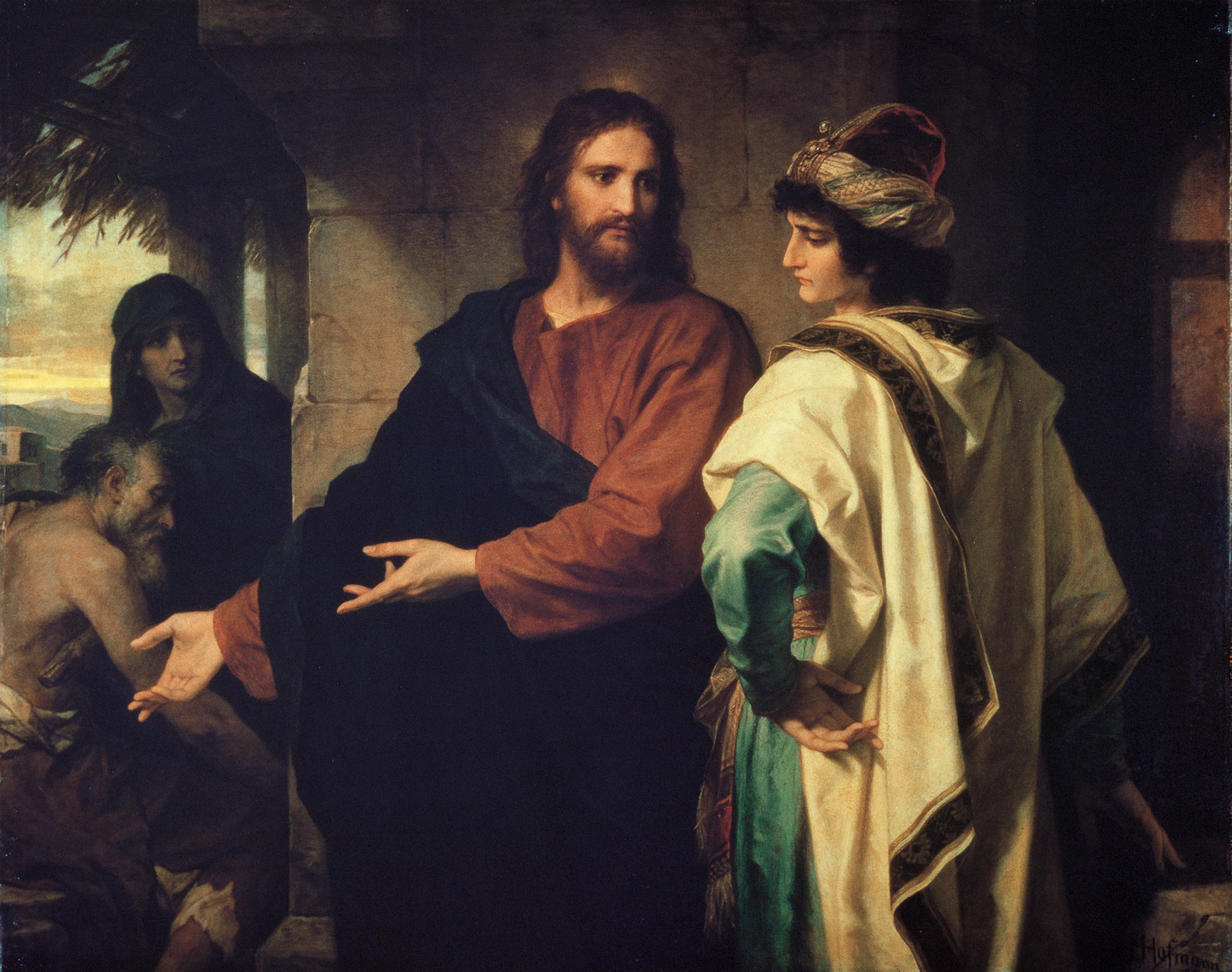
How does the young man behave?
How does Jesus behave?
What is happening in the background?
The young man could not take any side. He is good, keeps the commandments, but lacks zeal, cannot sacrifice himself and engage fully.
How is it with us?
What can we sacrifice for our faith?
Do we engage in faith fully, or do we choose only elements convenient for us?
You cannot be a “believing-non-practicing” “a bit of a Christian” or “a Catholic, but without exaggeration”. Either I am a Christian, or I am not. We cannot be “sympathizers” who treat faith loosely and non-bindingly. Possible goals are only two: 0% or 100%. (Of course, we are not perfect and at a given moment of our life we may be able to afford only 75%, but our goal should always be 100%. We cannot set a goal for 60% and wonder why it goes badly, is gray and bland).
Only Fully
Note
5 minutes
If Christianity, then fully - only such makes sense
What does “fully” mean? What are the determinants?
Let’s read:
“Blessed are the poor in spirit, for theirs is the kingdom of heaven.Blessed are those who mourn, for they shall be comforted.Blessed are the meek, for they shall inherit the earth.Blessed are those who hunger and thirst for righteousness, for they shall be satisfied.Blessed are the merciful, for they shall receive mercy.Blessed are the pure in heart, for they shall see God.Blessed are the peacemakers, for they shall be called sons of God.Blessed are those who are persecuted for righteousness’ sake, for theirs is the kingdom of heaven.Blessed are you when others revile you and persecute you and utter all kinds of evil against you falsely on my account. Rejoice and be glad, for your reward is great in heaven, for so they persecuted the prophets who were before you.—Mt 5:3-11
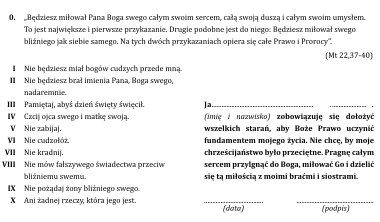
If you join a club, you accept all its rules, and not choose only those that suit you best (no religious cafeteria). At today’s evening prayer, we will ask for grace so that what we talked about at the meeting we manage to implement in life. The most basic determinant of radical serious commitment to faith is the 10 commandments. Today’s prayer will be giving to God our resolution to undertake a life radical with the Gospel.
Note
This is a good moment to hand participants cards for the evening prayer
Content of cards:
Application
Note
1 minute
I will read Heb 11 and get to know the story of one person listed there whom I do not know (if there is such one)
I will write down in a notebook things that I do 100% in life and those in which I do not want or cannot engage fully.
Prayer at the End of the Meeting
Note
4 minutes
Prayer of entrusting our Christianity to God, request that He enable us to be Christians seriously, to build His Kingdom wherever He sends us. A proposal for the end of this prayer is a fragment of Psalm 51:
Create in me a clean heart, O God,and renew a right spirit within me.Cast me not away from your presence,and take not your Holy Spirit from me.Restore to me the joy of your salvation,and uphold me with a willing spirit.Then I will teach transgressors your ways,and sinners will return to you.Deliver me from bloodguiltiness, O God,O God of my salvation,and my tongue will sing aloud of your righteousness.O Lord, open my lips,and my mouth will declare your praise.—Ps 51:10-15