Meeting 1 — Sukkot
Introduction for the facilitator
The first group meeting serves an introductory and integrating function. We would like the meeting to allow experiencing and summarizing the first day of the retreat. In the first meeting we would like to place emphasis on HOSPITALITY. Hospitality understood as the next step after openness and going out to others. It is us who are to give a hospitable space, to which we invite others, so that they can go out to people.
The meeting requires preparation of materials (At the end of the outline - for self-printing on one’s own and distributed on site). Do not forget them.
Introduction
We start with prayer - form according to the animator’s discretion, with particular emphasis placed on the request for openness to another human being. It is about readiness to accept and host them in one’s space as they are – with their traits, talents and perspective. Jesus teaches us this, confronting people with a way of thinking different than the one they knew and to which they were used.
If there are people in the group without experience in sharing meetings, the animator briefly explains their idea and discusses basic rules.
We start with greeting and getting to know each other.
We ask everyone for a short introduction. Say a few sentences about yourself, have you been to the Ponad Murami retreat before.
Then we share impressions from the conference.
What contents from the conference resonate most with what has been happening lately in my life?
What moved me?
Then we immediately move to the workshop part.
Warning
It is important to stick to individual times, because only then will it be possible to realize the full workshop. We realize that this requires concentration on time. It is good to turn on a timer for each exercise so that participants see how much time they have until the end of the task.
The workshop aims to help participants experience what openness to another human being and diversity of people around us is (together we create a group, retreat space and Church, we meet there TOGETHER). The workshop teaches participants openness and consent to diversity around us, to other people and to creative, often unexpected action of God in our life through other people. It is worth paying attention to:
Experience of change – Participants will experience on their own skin what it is like when someone interferes with their “work”. This can evoke different emotions, which is an excellent starting point for reflection on openness.
Work on control and attachment – Teaches flexibility and the ability to let go of control over something they created.
Participants will see how others can enrich their work or change it, which shows that openness can lead to new, unexpected results.
Interaction and building community – Creates a space for conversation, sharing impressions and getting to know each other better.
Challenges and possible difficulties:
Emotional reaction – Some may feel frustration if their figurine is changed in a way they do not like.
Risk of lack of engagement – If someone does not identify with the message of the exercise, they may treat it superficially.
Adaptation to the group – Depending on the group, it is worth adapting the reflection after the exercise.
Workshop
Note
The animator puts out a box with pieces of technical plasticine (set released before the meeting). They do not show the box with additional decorations.
Short introduction - Explain that it is about the experience of openness, not judging or criticism. Everyone takes a piece of plasticine, one piece is left so that one can take more in subsequent stages.
Instruction:
Distribute soft plasticine to each participant. They have 3 minutes to create a figurine – an animal or favorite thing. They can give their work names.
After three minutes ask why they created such a figurine (we have about 5 minutes for this). Participants are after introductions, probably they paid attention to various contents from today, finally our figurines are certainly quite different. Summarize briefly the current part of the workshop. Pay attention to the fact that each of the participants had a different idea for the figurine, just as we come from different environments and are at different stages in life. However, we meet here together to mutually draw from each other - similarly to Jews in Sukkot.
Then we move to the next part of the workshop. Take out the box with additional elements (decorations etc.).
Ask participants to pass their work to the person on the left. The new creator has 2 minutes to introduce any change - with the proviso that the change must add something (one cannot completely remake the figurine).
Repeat this once more - the figurine passes to the next person, who again has 2 minutes for modification - again the same rule regarding change.
At the end figurines return to their original creators. Each person has an additional 2 minutes to undo or add some modifications.
Reflection and summary
Let’s ask ourselves questions:
What did you feel when someone changed Your work?
What feelings accompanied You when you gave your figurine to others? (curiosity, fear, reluctance to give it away, …)
Did the possibility of seeing ideas of other people (for Your figurine, but also figurines of other people) give You something?
In this exercise you gave space to other people to open up and show their perspectives by modifying your figurine. You invited them to yourselves and opened up to them co-creating your space (this is different from the situation “you can enter, but do not touch anything”). You yourselves also co-created the space of others and shared a part of your skills to show your view. This is the realization of the principle “Who visits me creates me”.
Emphasize that our life and plans can be changed – by people, by circumstances, but also by God. HOSPITALITY is the ability to accept others with trust and openness. It is acceptance and accompanying the other in the stage of life they are in. Without interference, rejoicing in what this person experiences, allowing it and remembering this time in oneself. For example, one should not extinguish childlike faith, although with time this faith will become much more mature - it is a stage.
HOSPITALITY does not mean accepting everything thoughtlessly, but the ability to listen, learn and be ready for new experiences. Just like with a guest - not every behavior of a guest (for example aggression) must be accepted by us.
He who receives you receives Me, and he who receives Me receives Him who sent Me.
—Mt 10:40
Hospitality as wisdom of the heart
Let us read:
He who has no experience knows little, but he who has traveled has increased his prudence.
—Sir 34:10-11
Did you have a travel experience in your life that in some perhaps smaller, perhaps larger degree changed You and Your way of perceiving reality?
Travels educate, but what educates in them most are meetings with other people, not just book knowledge about other countries. Hospitality gives the possibility of making a journey without leaving home - similarly as in a journey we have the opportunity to meet another human being and God in another human being. It is not acquiring information, it is experiencing another human being.
Reversal of logic
The animator starts with a question:
What can block us in being hospitable?
Listen to the answers. If an answer regarding lack of resources (we have nothing to share) does not fall - suggest such an answer asking if it can block us.
Note
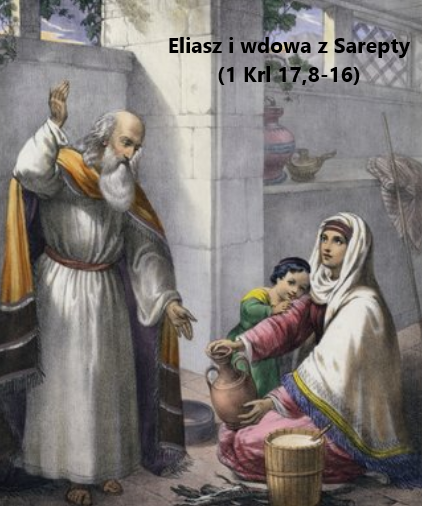
We take out the first picture with the widow
|
The widow had very little food, probably sold everything she could and planned to prepare the last meal for herself and her son, she had nothing for the prophet. She trusted Elijah’s word and in times of famine shares the last meal. Result: Her supplies miraculously did not run out, and later Elijah resurrected her son. “Do not neglect to show hospitality to strangers, for thereby some have entertained angels unawares” (Heb 13:2) |
Let us read:
Then he arose and went to Zarephath. And when he came to the gate of the city, behold, a widow was there gathering sticks. And he called to her and said, “Bring me a little water in a vessel, that I may drink.” And as she was going to bring it, he called to her and said, “Bring me a morsel of bread in your hand.” And she said, “As the Lord your God lives, I have nothing baked, only a handful of meal in a jar and a little oil in a cruse. And now I am gathering a couple of sticks that I may go in and prepare it for myself and my son, that we may eat it and die.” And Elijah said to her, “Fear not; go and do as you have said; but first make me a little cake of it and bring it to me, and afterward make for yourself and your son. For thus says the Lord, the God of Israel, ‘The jar of meal shall not be spent, and the cruse of oil shall not fail, until the day that the Lord sends rain upon the earth.’” And she went and did as Elijah said. And she and he and her household ate for many days. The jar of meal was not spent, neither did the cruse of oil fail, according to the word of the Lord that he spoke by Elijah.
—1 Kgs 17:10-16
What was the result of her hospitality?
Could she have chosen differently?
Was it easy to be hospitable in this situation? How would You act in her place?
Note
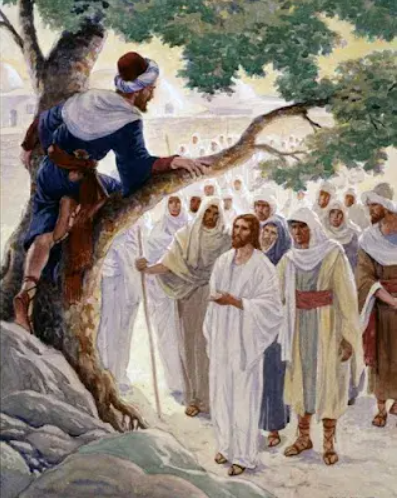
We take out the second picture with Zacchaeus
|
Zacchaeus - despised by all tax collector, rich, short. Jesus did not reject people despised by others. Jesus’ openness prompted Zacchaeus to invite Him to his house, which ultimately was the cause of Zacchaeus’ transformation. Being short he used what he could (tree) to see Jesus, about whom he heard. He did not care that people would see him sitting on a tree, that perhaps they would have a subject for mockery. What prompted him to this? Need for change, spiritual transformation? |
Let us read:
He entered Jericho and was passing through. And there was a man named Zacchaeus. He was a chief tax collector and was rich. And he sought to see who Jesus was, but could not on account of the crowd, because he was small of stature. So he ran on ahead and climbed up into a sycamore tree to see him, for he was to pass that way. And when Jesus came to the place, he looked up and said to him, “Zacchaeus, make haste and come down; for I must stay at your house today.” So he made haste and came down and received him joyfully. And when they saw it, they all murmured, “He has gone to be the guest of a man who is a sinner.” And Zacchaeus stood and said to the Lord, “Behold, Lord, the half of my goods I give to the poor; and if I have defrauded any one of anything, I restore it fourfold.” And Jesus said to him, “Today salvation has come to this house, since he also is a son of Abraham. For the Son of man came to seek and to save the lost.”
—Lk 19:1-10
What was the result of his hospitality?
Was it easy to be hospitable in this situation? How would You act in his place?
Summary:
In Sukkot we are in tents, but it is a feast of abundance. We feast, even though we are away from home. In Christianity, we invite children to the Eucharist - to participate in the mystery. One does not need to wait until we are fully ready, until we have a fully furnished apartment. We can and should abound already now.